
Yesterday’s Playbook Fails Because Disruption Never Clocks Out
Supply chain risk used to show up on a calendar. Hurricane seasons, labor contract renewals, the occasional recession.
You planned around it, dusted off the plan when you needed to execute and moved on.
Four years ago in Insightful Leadership, I wrote that such a world is gone. Nothing since has proven me wrong.
Risk now shows up daily.
June saw news reports of a ransomware attack on the Adriatic Port Authority. Although the authority downplayed the damage, it shows the danger of maritime security attacks in a digital age. Ransomware groups have disrupted ports in the past, and they will in the future.
Also in June, a fragile ceasefire reopened the Strait of Hormuz to commercial shipping. However, transit volumes swung wildly, from 22 ships a day to 70, depending on the week. And now, at least as I’m writing this, the cease-fire is over.
Meanwhile, trade professionals report tariff volatility as their top supply chain disruption risk. And that concern has roughly doubled in a single year.
None of those three things made the same headline twice. That’s the point. Supply chain leaders used to prepare for the big, nameable event. Now they’re managing a constant drip of small, unnamed ones, and most organizations still run their planning process like it’s 2015.
That’s not going to deliver supply chain resilience.
Supply Chain Risk Is All About the Planning, Not the Plan
Gen. Dwight D. Eisenhower put it best: “Plans are worthless. But planning is everything.” He commanded the largest logistics operation in human history, and he wasn’t being clever. A paper plan meets reality once, then starts decaying immediately.
Most organizations still treat the plan as the deliverable. Write it, get sign-off, file it, move on. Reality changes the day after the ink dries, and the plan sits there, wrong.
Trade deals used to anchor long-term sourcing decisions for a decade or more. Not anymore. On July 1, the United States declined to renew the USMCA for a fresh 16-year term. The agreement stays in force, but only until 2036.
Instead of another long stretch of certainty, it now faces annual review. Companies built sourcing strategies assuming a stable trade backdrop. They’re relearning a hard lesson: trade policy is a variable that can shift every year, not a fixed input.
That’s what makes supply chain risk management different from a decade ago. The plan can’t just anticipate one disruption and call it done. Your company teams must anticipate moving targets, because disruptions come annually, monthly – or even faster.
So no matter what, your plans will age out.
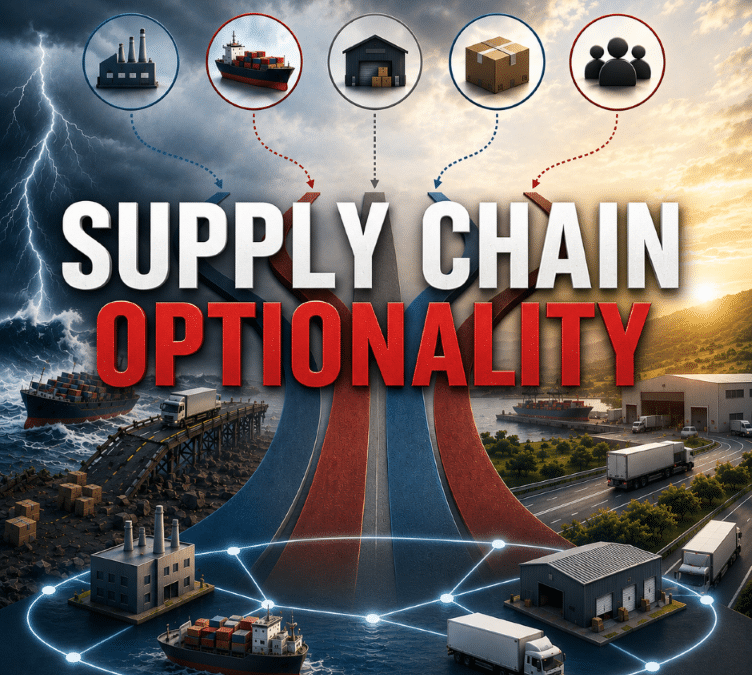
But that planning document never was your protection. The process was. Your teams conduct the scenario thinking, supplier mapping and the ongoing work that builds supply chain resilience. That develops optionality.
So even after your binder goes stale, supply chain resilience can survive.
How AI Helps Reduce Supply Chain Risk
I’ve watched supply chain leaders argue for years about whether AI is worth the investment. My answer is simple: adopt it, but not for the reason most people expect.
The value isn’t that AI predicts the future. Nobody does that reliably, artificial intelligence included.
The value is speed. A quarterly supply chain risk review is already three months stale by the time anyone reads it. Real-time data changes that math entirely.
Take weather. NOAA issued an El Niño Advisory in July and expects it to keep intensifying into winter, with real odds of reaching “Super El Niño” strength. El Niños increase the chance of drought and extreme weather. Droughts have limited the number of ships that can transit the Panama Canal in the past. And that seems likely to happen again.
A quarterly report catches that shift after your ships have already gotten stuck. A live feed catches it beforehand, so you can develop optionality.
That’s the actual shift AI creates. You move from reviewing what already happened to watching what’s happening now. Artificial intelligence tools do not replace your judgment. But they can shorten the lead time on making decisions that minimize supply chain risk.
Optionality Beats a Binder Full of Good Intentions
So where does that leave you?
Not with a bigger binder. A binder full of contingency plans for every named threat sounds thorough. But can anybody catalog every natural disaster and geopolitical conflict in advance? No, you can’t.
What you can do is build the muscle. Carry safety stock on the inputs that would actually shut you down, not just the ones that are easy to forecast. Qualify multiple suppliers before you need them, not after the first one fails. Treat scenario planning as a habit, not an annual event you check off before budget season.
None of that guarantees you’ll dodge the next disruption. But it gives you real ways to manage supply chain risk when it hits.
That’s the entire case for optionality. Optionality can make the difference between a company that survives an unexpected event and one that tanks three months later.
I’ve spent 50 years watching organizations chase efficiency at the expense of resilience. The efficient ones looked smart until the day they weren’t. The resilient ones are still standing.
Are you still measuring supply chain risk management by how tight your costs are? Or by how many options you have left when something breaks? I’d love to hear how you’re thinking about that. Drop me a line.
Related Reading
- Part III: Rip Van Supply Chain Wakes Up to New Execution Models
- The Panama Canal’s Future Is Bigger Than the Canal
- Why Freight and Parcel Shipping Require Post-Auditing

Jim Tompkins, Chairman and founder of Tompkins Ventures and Tompkins Solutions, is an international authority on designing and implementing end-to-end supply chains. Over five decades, he has designed countless industrial facilities and supply chain solutions, enhancing the growth of numerous companies. Jim earned his B.S., M.S. and Ph.D. in Industrial Engineering from Purdue University.