
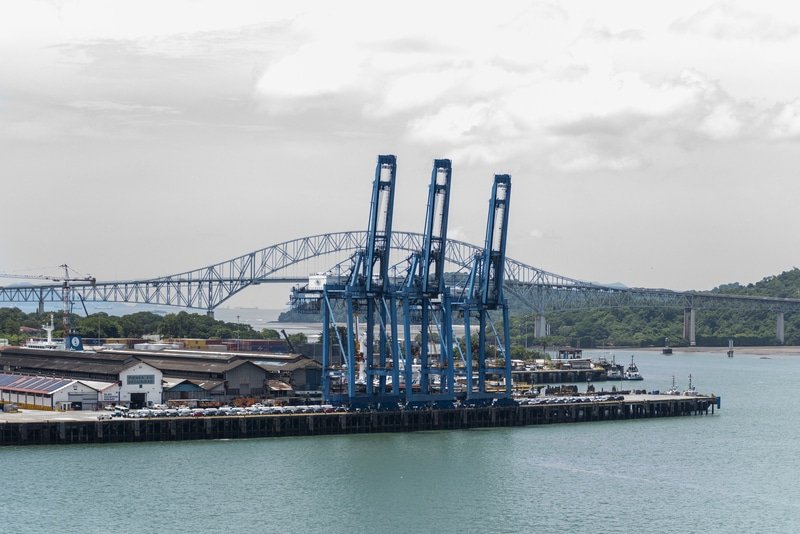
Engineers Can Fix Some Things – But Not Geopolitics
Modern civilization runs on a surprisingly small number of waterways. While geopolitical problems engulfing The Strait of Hormuz dominate current headlines, the Red Sea and the South China Sea are all under pressure. That pressure is exactly what makes the Panama Canal’s future so consequential – and so misunderstood.
The canal has linked the Atlantic and Pacific Oceans since 1914. In recent years, periods of droughts have increased, limiting the number of ships that can transit each day.
Engineers can fix that problem. And they are. The Panama Canal Authority (ACP) plans to spend $8.5 billion on modernization, including a water reservoir, new port terminals and a gas pipeline.
Unfortunately, engineers cannot fix politics. And with politics and wars turning waterways into chokepoints, global trade needs a trusted asset. The Panama Canal is that trusted asset – if the world knows how to use it.
Some of the World’s Shipping Corridors Are Becoming Chokepoints
Roughly 80% of international trade by volume moves by sea. As we have seen in the last few years, when a waterway becomes unstable, entire supply chains feel the consequences – fast.
Fighting has curtailed trade routes through the Red Sea and the Strait of Hormuz. Before that, headlines focused on whether China would disrupt shipping through the South China Sea.
By some estimates, The South China Sea handles roughly one-third of global shipping. That figure is in dispute, and you can dive into that decade-old fight if you want.
Either way, billions of dollars in trade ships through that waterway annually. And China, Vietnam, the Philippines, Taiwan, Malaysia and Brunei all have overlapping claims in the sea.
In recent years, China has become increasingly assertive. The nation has constructed ports, military installations and airstrips on disputed islands. The Chinese government considers Taiwan a breakaway province, not a sovereign country.
China’s armed forces have repeatedly staged military exercises around Taiwan. And China has never renounced the possibility that it will take Taiwan by force. No treaty requires the United States to defend Taiwan against an attack.
But the Taiwan Relations Act states that the U.S. should “make available to Taiwan such defense articles and defense services in such quantity as may be necessary to enable Taiwan to maintain a sufficient self-defense capability” and “to maintain the capacity of the United States to resist any resort to force or other forms of coercion that would jeopardize the security, or the social or economic system, of the people on Taiwan.”
That mouthful of diplomatic ambiguity could trigger a war if China ever invades Taiwan.
The situation is less ambiguous elsewhere. Under the U.S.-Philippines Mutual Defense Treaty, each country must respond to an armed attack on either nation’s forces in the Pacific.
Russia. Houthis. Hormuz. The Hypothetical Becomes Real
While the world had its eyes on potential problems in the South China Sea, real wars drove home the point that global trade depends on a handful of waterways. In rapid succession, Russia-Ukraine, Houthi missiles and the Strait of Hormuz conflict hit global shipping.
Before 2022, Russia was a major exporter of crude oil and petroleum and Ukraine was a major exporter of grain.
Now, despite sanctions, Russia continues exporting oil through a shadow fleet and new trade channels. China has absorbed 49% of Russia’s crude exports since the invasion, with India taking another 37%.
For its part, Ukraine has returned freight rates to near pre-war levels. Maritime routes again handle 92% of Ukraine’s corn, wheat and soybean exports.
The Houthi missiles shut down the Red Sea, which connects the Suez Canal to the Indian Ocean. Carriers diverted around the Cape of Good Hope, adding 3,500 nautical miles and up to 10 days. About 12-15% of worldwide trade and 30% of global container traffic transit Suez annually.
The attacks largely stopped in late 2025. But even after conditions improved, Suez Canal traffic has not fully returned to pre-2023 levels. Carriers continue weighing risks and insurance costs.
The Strait of Hormuz became the next crisis. Following U.S. and Israeli attacks on Iran in February 2026, Iran closed the strait. Roughly 27% of the world’s seaborne oil trade moves through that narrow passage – along with about 20% of global liquefied natural gas.
Now, the U.S. and Iran have announced a cease fire and a deal. Hopefully, it holds. But while Iran held a stranglehold on the strait, the flow of oil remained far below the previous volume of 15 million barrels a day.
Trade will usually find a way. But wars have altered trade routes, increased transportation costs and forced exporters to develop alternative logistics networks.
The Panama Canal’s Future: Keeping Trade Flowing
Against that backdrop, the Panama Canal’s future stands out. Yes, disruption can and has hit the canal. But unlike other geopolitically difficult waterways, the canal remains strategically valuable and reliably neutral.
People underestimate the canal by measuring it as a share of global trade. The canal “only” handles close to 3% of all global maritime trade.
But the canal’s value lies in its connectivity. Remove it from the map and the ripple effects would touch nearly every major economy in the Western Hemisphere – and beyond.
The canal connects the arteries of commerce in the Western Hemisphere. It links the U.S. East Coast to Asia and South America’s West Coast. It links South America’s West Coast to Europe. And it links South America’s East Coast to Asia.
According to the Panama Canal Authority’s latest annual report, nearly 70% of canal cargo either originates or terminates in the United States. Roughly 40% of all U.S. container traffic flows through it. Connect the dots and you have 180 routes, 1,920 ports and 170 countries.
The Canal Is the Floor, Not the Ceiling
The canal’s neutrality and reliability are genuine strategic advantages. But they are not Panama’s ceiling.
Over the past several decades, Panama has evolved from canal operator to port operator to regional logistics center.
The Colón Free Zone is the largest free trade zone in the Americas and the second largest in the world, behind only Hong Kong. Panama’s ports handled nearly 9.9 million TEUs in 2025 – a 3.6% increase over 2024. That volume ranks in the top 10 for all ports in North and South America.
And Panama City has become a genuine magnet for multinationals. Companies like Maersk, Dell, Nestlé and BMW have established regional headquarters there under Panama’s SEM regime. Twelve new companies joined in 2024, followed by 13 more in 2025 – representing $37.3 million in new investment.
That trajectory is accelerating – not because of anything Panama did alone, but because the world is reorganizing around it. As companies respond to perpetual disruption through nearshoring, friendshoring and ReGlobalization, the Western Hemisphere is growing in strategic importance. Trade flows are reorienting. Companies that once ran supply chains through a single Chinese supplier now want options in Mexico, Colombia, Brazil, the Dominican Republic and beyond.
Panama sits at the geographic center of all of it. Its ports serve both oceans, its time zone aligns with the U.S. business day and its infrastructure and financial systems are sophisticated by regional standards.
Those advantages don’t stop at the water’s edge. The country hasn’t finished building, but the Panama Canal’s future needs one more thing.
The Western Hemisphere Needs a Command Center
Frankly, before the 2020 pandemic, most executives took supply chain for granted. And before the container ship Ever Given blocked the Suez Canal for six days in 2021, the C-suite focused on factories and warehouses, not how much supply chains rely on water transportation.
Supply chains do not stop when geopolitics erupts. Companies must move containers and deliver to customers. Disruptions simply change the cost, the time and the risk.
Now, ReGlobalization is creating demand for something that doesn’t yet fully exist: coordinated, hemisphere-wide supply chain visibility and execution.
Companies need to track goods moving from a factory in Monterrey to a distribution center in Ohio. They need visibility into a container moving from Cartagena through the canal to Savannah. They need to know what’s happening in Brazil, Central America and the Caribbean – in real time.
No single platform does that today. No single node coordinates it.
That’s exactly why the Panama Canal’s future matters beyond the canal itself. The infrastructure is already there – the canal, ports, free trade zone and financial system. What’s missing is the orchestration layer that ties it together at hemispheric scale.
For years, Tompkins Ventures has argued that Panama’s highest-value opportunity lies in becoming exactly that node – a Western Hemisphere Supply Chain Command Center. Not a government agency, but a genuine hub for trade intelligence, logistics coordination and supply chain decision-making.
The conditions have never been more favorable. The question is whether Panama – and the companies smart enough to position themselves around it – move before the next crisis forces their hand.
