
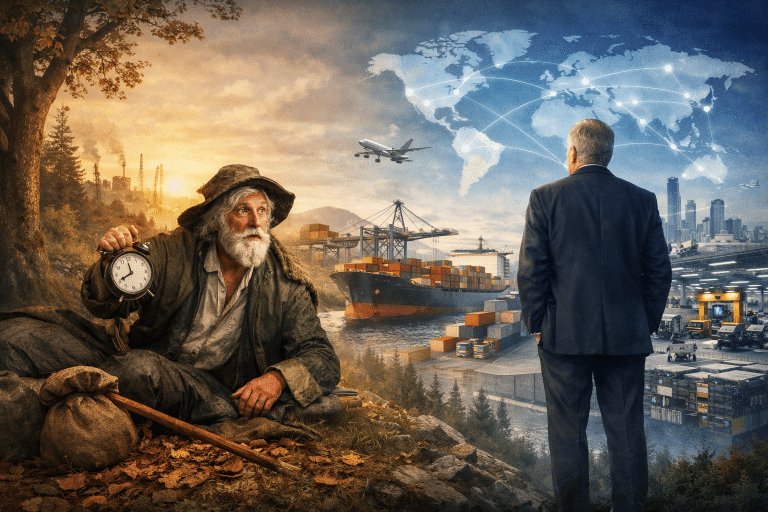
What You See Now on the Floor and at Industry Shows
Rip Van Supply Chain has seen the world and the systems change. Now he’s walking the floor – and operating inside new execution models.
For me, that’s not just an analogy. I spent 45 years inside supply chain operations. Then I stepped away from daily operations to build Tompkins Ventures. It was worth it to focus on entrepreneurship, partnerships and where the industry was going.
Now, back in operations as chairman of Tompkins Solutions, my vantage point has changed again.
It feels a bit like Rip Van Winkle waking up. Just like in Washington Irving’s story, the world had moved on. In my world, the systems have moved on with it. And in the third and final part of this series, I’ll explain how and where work has changed.
You can see it in how retailers fulfill demand that no longer fits inside four walls – where stores now fulfill online orders, even for products not carried in-store. How warehouses coordinate people, automation and flow in real time. And how intralogistics determines whether operations keep up or fall behind.
And you can also see it in how individuals approach their roles – at work and on the show floor, where what used to be equipment demonstrations now show how work flows through the operation.
ECommerce Is Not A Novelty But A Necessity
In 2010, some retailers could get away with ignoring eCommerce. U.S. consumers ordered about $165 billion worth of goods online, about 4.2% of U.S. retail.
Fast forward to today, and that number is approaching $1.2 trillion, according to the U.S. Census Bureau. That 7x increase – or about 16% of retail – translates into roughly 14% annual growth over 15 years.
Yes, that means that stores still dominate, as they handle roughly 84% of U.S. retail sales. But stores are also key for eCommerce growth, as some retailers fulfill 50% – or more – of online orders through stores.
And focusing on share misses how much operations change. Retailers cannot afford to underbuild for a $1.2 trillion channel that spikes even higher in peak season. And by including online sales in execution models, retailers can offer consumers more – much more than what fits inside a physical footprint.
Home Depot, one of the chains that fulfills more than 50% of its online orders from its stores, is a perfect example.
The average store carries about 105,000 square feet of product – maybe 30,000-40,000 SKUs. But the home improvement retailer offers more than 1 million SKUs online as part of its broader order fulfillment strategy.
Extending shelf space without endless real estate can be even more critical for smaller operations. While small- and midsized operations cannot build a nationwide distribution network, they can take advantage of best-fit 3PLs to support logistics operations beyond their point of origin.
Clearly, eCommerce has not replaced your physical stores. Online ordering has, however, redefined the retail space and your operational models.
One out of every six orders is more than enough to dictate changes in inventory strategy, fulfillment design, delivery expectations and capital allocation.
Now, your stores are fulfillment nodes, inventory hubs and final-mile engines.
WES Is Replacing WCS as the Brain of the Operation
That shift in fulfillment doesn’t stop at the store level. It carries directly into how execution models work inside the four walls.
For years, warehouse control systems (WCS) managed equipment-level operations. They sent precise instructions to automation hardware, ensuring conveyors move, sorters route items and robots complete defined tasks.
But that type of automation has its limits. Your WCS cannot balance labor, reprioritize orders or dynamically shift resources across the warehouse. As warehouses became more complex, that narrower scope started to look insufficient.
That matters more now because eCommerce has changed the flow. Spikes in order volumes, varied order profiles and fulfillment speed drive customer service.
On the other hand, warehouse execution systems (WES) can dynamically release work, balance workloads between people and machines and sequence tasks based on priority in real time. In modern deployments, WES often incorporates WCS-like control functions while also adding decision-making capabilities.
The shift from WCS to WES changes warehouse performance in several practical ways.
First, it improves throughput by reducing bottlenecks and keeping work moving where capacity exists. Second, it shortens order cycles by prioritizing urgent tasks automatically instead of waiting for manual intervention. Third, it can reduce labor waste by balancing workloads more effectively across the floor.
For example, imagine a fulfillment center where a wave of same-day orders arrives while one sortation line slows down. A WCS might continue executing its preprogrammed commands. But a WES can reroute work, shift priorities and release tasks differently so delays do not cascade across operations.
That ability to adapt in real time makes WES feel like the brain of the warehouse.
That orchestration role is especially valuable in hybrid facilities where manual picking, robotics, and automated transport all coexist.
Intralogistics Is Now Reality
You can orchestrate the work perfectly. But if the flow breaks down, the system still fails.
That’s the role intralogistics plays.
Many people think logistics is all about trucks, ships and planes. But the first engine of your supply chain isn’t on the road or at the port – it’s inside your four walls. That’s intralogistics: how people, technology and material handling equipment move inventory through your distribution or fulfillment center.
When intralogistics works, your operation hums with speed, accuracy and efficiency. When it doesn’t, you bleed time, money and customer trust. Think of intralogistics as the hidden system that either keeps your supply chain delivering or trips it up. It’s everything from conveyors and robots to software dashboards and slotting strategies.
Intralogistics handles internal material transport; inventory and information management; and distribution/fulfillment center operations.
Despite its importance, leaders often overlook intralogistics until they start seeing lagging indicators (missed SLAs, customer complaints, etc.).
By this time, it’s too little, too late. The damage has been done to customer confidence, business profitability and even employee morale.
21st century distribution and fulfillment centers face high order volumes, an overload of SKUs and tight shipping deadlines – challenges that depend on how well internal processes actually run. As a result, top-tier companies invest in intralogistics to increase throughput and accuracy. Automation, software and data can improve performance – but only when applied to how work actually flows.
People Don’t Want Jobs the Same Way Anymore
One of the more visible changes in today’s execution models is how the work gets done.
For years, most operations depended on a stable, scheduled workforce. People had jobs. They showed up at a set time, worked a set shift and filled a defined role inside the operation.
That model no longer covers the full need.
Many people today do not want the constraints of a fixed schedule. They have other priorities – family obligations, school, second careers or simply a preference for flexibility. At the same time, they still need income and want the satisfaction that comes from doing a job well.
That means choosing when and where to engage. They can take on work, perform well and step back without the constraints of a traditional schedule – a level of flexibility that matches what’s happening in supply chain operations.
Demand doesn’t arrive evenly anymore. It spikes, then slows. Then it compresses into shorter windows. Traditional labor models struggle to keep up because they were built for consistency, not variability.
That’s where labor on demand starts to matter.
Companies can tap into a flexible pool of workers who step in when demand requires it. These workers don’t commit to a traditional job. They choose to work specific tasks, at specific times, based on their availability.
From an operational standpoint, that means building a model that can expand and contract as needed.
That improves responsiveness, reduces the strain on full-time teams and aligns labor availability more closely with actual workload. Labor on demand does not replace your full-time employees. Core teams still matter for stability, leadership and continuity.
But around that core, the model is changing.
Execution today requires both structure and flexibility. It requires a workforce that can handle the base load and one that can respond when conditions shift.
It Isn’t Your Grandfather’s Material Handling Show
I saw how all of this plays out when I walked the floor at MODEX 2026 a few weeks ago in Atlanta.
Material handling exhibitions have changed over the past decade. I used to look forward to equipment-centric showcases – conveyor speed, sorter throughput and mechanical efficiency. MODEX showcased the shift from hardware to orchestration, from machines to systems and from capacity to adaptability.
Historically, buyers compared units per hour, uptime and footprint. Those metrics still matter. But how systems sense, decide and respond in changing conditions matters even more.
Artificial intelligence accelerated this shift. At MODEX 2026, leading solutions adjusted workflows in real time based on demand, inventory and downstream constraints.
Robotic systems showed an ability to adapt in real time. Instead, they respond to what is happening in the operation. AI now handles more of those decisions, which changes the role of labor.
Yes, humans remain in the loop. But they spend more time managing exceptions, supervising intelligent systems and stepping in when systems encounter ambiguity or disruption.
Unfortunately, some attendees walked around like they were in a nap. Many have not recognized that execution models have changed.
They looked at equipment, not systems. They compared specs instead of capabilities, asked about throughput instead of adaptability and looked for ROI in isolation instead of system impact.
It’s time for the whole industry to wake up to the new world. Exhibitors at MODEX and other material handling shows shouldn’t view these events as product showcases. Instead, they should prove how their systems get work done going forward.
The companies that see this shift will redesign their operations for competitive advantage.
The ones that don’t go home with brochures.
Rip Is Awake – Now He Has to Run New Execution Models
Some companies are already adjusting how they design and run their operations.
Others are still trying to make old execution models fit a system that doesn’t behave the same way.
Stepping back into operations has made that clear to me. I saw evidence of both when I walked the floor at MODEX. And I hear evidence of both in my regular conversations with CEOs and supply chain executives worldwide.
If you’re seeing that tension inside your own network, your facilities or your teams, it’s worth a conversation.
Because if you want to move the business forward, you cannot ease into it. You cannot keep napping.
Rip doesn’t get that option anymore.
Related Reading
- Part I: Rip Van Supply Chain Disruption Missed the Shift
- Part II: Systems Changed While Rip Van Supply Chain Slept

Jim Tompkins, Chairman and founder of Tompkins Ventures and Tompkins Solutions, is an international authority on designing and implementing end-to-end supply chains. Over five decades, he has designed countless industrial facilities and supply chain solutions, enhancing the growth of numerous companies. Jim earned his B.S., M.S. and Ph.D. in Industrial Engineering from Purdue University.