
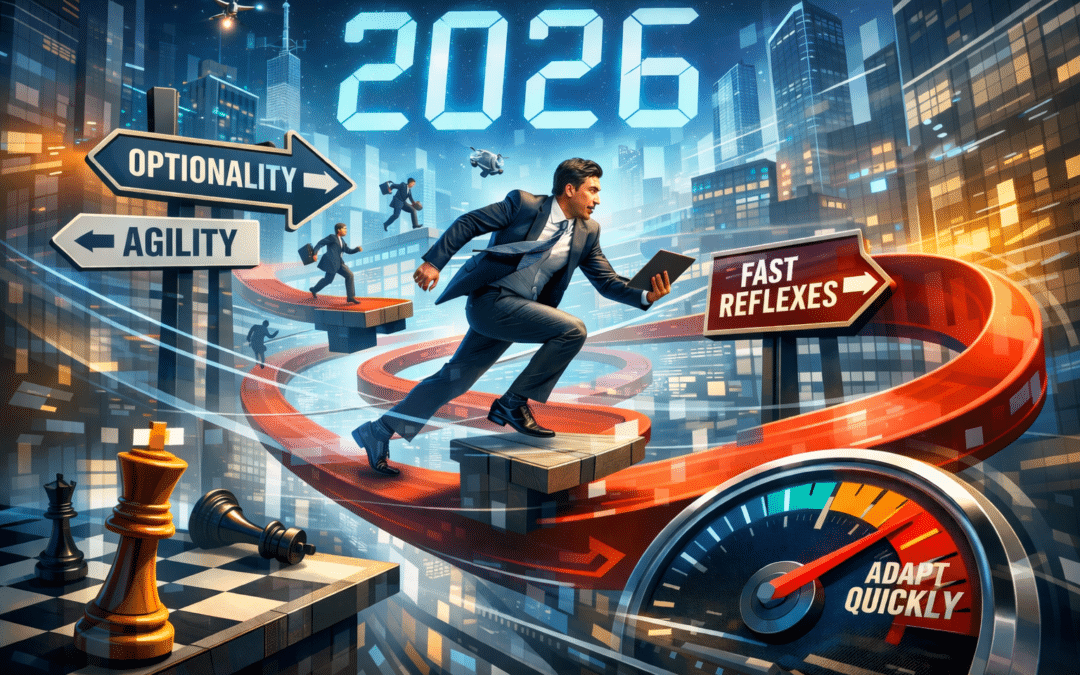
Welcome to 2026 – But Reality Is Not What You Think It Is
Annual planning. Annual thinking. Set goals. Happy New Year.
We dust off those phrases at appropriate times – fall/winter to set goals for the next year, then “Happy New Year!” in January.
For most of our careers, that rhythm made sense. You set objectives, executed through the year and measured success in December.
Then we restarted the rhythm each January, when “Happy New Year!” meant “I hope the next 12 months treat you well.”
Even a few weeks ago, many leaders still behaved as if the calendar flipped us back into a predictable, steady-state environment. Shut down in mid-December. Return to work after the holidays. Pick up where you left off.
But let’s be honest: the world you left before the holidays is not the world you just walked back into.
Not in business, family life or society.
We used to live in an annual rhythm – five days a week in the office, 45 hours of structured work, clear roles, clear boundaries and a business environment that rewarded discipline and consistency.
That world is gone. Today we operate in real time, in a VUCA (volatility, uncertainty, complexity, ambiguity) environment where disruption is the norm, not the exception.
So maybe “Happy New Year!” is outdated.
Maybe the more honest version is: Happy New Month.
Or even: Happy Next 12 Hours.
Because that, not annual planning, is the actual horizon many leaders are managing.
As we step into 2026, we’re not “returning” to anything. We are stepping into a landscape that is evolving faster than our old habits, calendars and assumptions. And that shift forces a fundamentally different way of thinking.
Here’s what that shift looks like:
1. Old: Annual Planning, Business Reviews and Goals
New: Real-time OKRs with Baseline, Expected and Stretch Results
The annual planning process worked when the world moved slowly. In 2026, they lag reality. Today, objectives and key results (OKRs) give leaders a dynamic way to track progress:
- Baseline = what traditional budgets used to assume
- Expected = the realistic midpoint given current conditions
- Stretch = the “art of the possible,” where innovation lives
This isn’t planning. It’s constant calibration in real time.
Because in 2026, the winners will move with agility, think with optionality and act with resilience.
2. Old: Continuous improvement (5% cost down, 7% sales up)
New: Breakthrough thinking and digital enablement
Incrementalism is dead. Targets to reduce costs by 5% and increase sales by 7% are relics of another era.
2026 demands step-change performance, powered by automation, artificial intelligence and new business models.
The question is no longer “How do we improve?”
It’s “How do we leap?”
Because in 2026, the winners will move with agility, think with optionality and act with resilience.
3. Old: Departmental focus
New: End-to-end, cross-functional performance
Customers don’t care about your org chart.
They care about outcomes.
Winning companies now address the entire value stream, not isolated functions. Silos slow down responses while integrations accelerates customer satisfaction.
Because in 2026, the winners will move with agility, think with optionality and act with resilience.
4. Old: Optimization based on historical data
New: Agility in a world where yesterday’s data may already be obsolete
Optimization assumes a steady state. Something annual planning can handle.
But in a world of perpetual disruption, the real advantage is the ability to pivot gracefully – moving from one solution to another without friction, drama or delay. Optionality beats siloed, optimized perfection every time.
Because in 2026, the winners will move with agility, think with optionality and act with resilience.
5. Old: Rigid strategies and alignment
New: Clear results, flexible strategies and organizational agility
Strategic planning no longer yields a detailed map. Instead, that process yields a set of guiding principles for strategic priorities.
What matters is clarity of results, speed of adaptation and resilience in execution.
Because in 2026, the winners will move with agility, think with optionality and act with resilience.
6. Old: 40-45 Hour Workweek with Clean Work/Family Separation
New: Blended life, blended roles, blended responsibilities
Work and family are no longer two lanes – they’re a roundabout.
Everyone participates, contributes and adapts. Leaders who pretend those boundaries still exist create friction instead of performance. The most effective organizations design work around outcomes and trust, not time clocks and artificial lines.
Because in 2026, the winners will move with agility, think with optionality and act with resilience.
So … Welcome Back to Work – and 2026
But let’s be clear: You’re not returning to where you were. You are not returning to annual planning, annual goals, annual thinking. You’re not even returning to “Happy New Year!”
You’re stepping into a new arena that rewards agility, curiosity, optionality, resilience and the ability to sense change, respond and operate in real time.
The companies that thrive in 2026 won’t be the ones with the best annual plans. They’ll be the ones with the best reflexes.
And maybe that’s the real meaning of “Happy New Year” now:
Happy new you.
Happy new team.
And happy new way of working.
Because the future isn’t waiting for anyone to “return.”
It’s already moving.
Related Reading
- Want to Be a Good Leader? Survey Says Get Ready for Ambiguity
- Insightful Leaders Peer into the Future, Not the Past
- The Future of Work Is Here — and It’s Not Going Back

Jim Tompkins, Chairman and founder of Tompkins Ventures and Tompkins Solutions, is an international authority on designing and implementing end-to-end supply chains. Over five decades, he has designed countless industrial facilities and supply chain solutions, enhancing the growth of numerous companies. Jim earned his B.S., M.S. and Ph.D. in Industrial Engineering from Purdue University.