
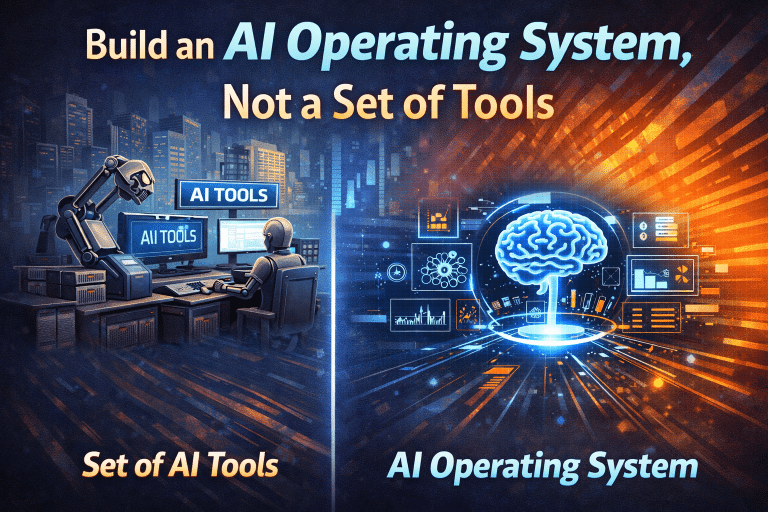
Many think they bought a factory. They’re still swinging a hammer.
If AI is not the operating system of your business, your teams are using it wrong.
I see the same pattern in company after company. Leaders invest in AI expecting meaningful gains – faster decisions, better forecasts, stronger margins. But in the real world, they only see small improvements in results.
That’s because companies use AI in two different ways. Most still treat it as a tool. Few are building an AI operating system.
That leaves most companies at Level 1, with the occasional outlier moving to Level 2.
And the gap between those two levels explains everything.
Executives think they’ve bought a factory. Their teams are still using a hammer.
The Mismatch No One Talks About
The executive level has clear expectations. Artificial intelligence should change how the business performs. It should improve speed, sharpen decisions and show up in revenue and margin.
On the ground, something very different is happening.
Teams experiment with it. They automate small tasks. They use AI-driven tools to draft emails, summarize documents and save a bit of time here and there.
While those results are good, they don’t add up to what leadership expects.
So executives start asking, “Where are the results?”
And the organization responds, “It’s helpful.”
Both are right. And that’s the problem.
The Two Levels of AI
At Level 1, companies use AI to help people do the work.
They automate tasks and improve efficiency at the margins. The work itself stays largely the same.
The gains are real but small. You might get 5% faster or 10% cheaper. Maybe you save a few hours.
Useful, but not enough to change how the business performs.
It’s the equivalent of giving every employee a better hammer.
At Level 2, companies use AI to rethink how teams work.
They redesign workflows and change how they make decisions. They rethink roles, teams and processes. The company builds AI models into operations instead of adding layers.
Increasingly, that includes using AI agents to perform tasks that once required manual effort and coordination.
The gains are not incremental. They change how the business performs. Work moves faster. Decisions improve. New capacity appears without adding headcount.
This is where artificial intelligence starts functioning as an AI operating system for the business. Not a tool people pick up when they need help, but the system work flows through.
Artificial intelligence should augment how the human brain processes information and makes decisions. That’s how an organization truly learns.
And that is the difference between using artificial intelligence and building an AI operating system.
This Gap Shows Up in Speed, Cost and Market Share
Most companies at Level 1 keep getting small wins and calling it progress.
The smaller group at Level 2 is redesigning how their business runs.
The difference shows up quickly.
Level 1 companies move a little faster, while Level 2 companies make decisions faster and act on them sooner.
Level 1 companies improve efficiency, while Level 2 companies change their cost structure.
Over time, that gap widens.
The companies operating at Level 2 perform better, adapt faster and learn quickly. They respond to the market before others even recognize what is happening. They create capacity they didn’t have before.
And once that gap opens, it is very difficult to close.
Build an AI Operating System, Not a Set of Tools
While most companies assume moving to Level 2 requires buying new AI or building their own agents, it doesn’t.
First, you have to figure out how to use what you already have, where it fits into your workflows. Then identify where real gaps exist.
That’s where experienced partners can help accelerate the shift.
In many cases, the tools you already use have AI built in – and more is being added every quarter. Microsoft is embedding agents across Dynamics 365, Copilot Studio and Microsoft 365. Other platforms are doing the same.
The shift to Level 2 often comes from using what you already have to change how work is designed.
Move AI from the edge of the organization into the core. Redesign workflows so teams use artificial intelligence to make decisions.
And rethink roles so people don’t just work – they oversee systems that do the work.
And it means measuring AI based on business outcomes – speed, margin, growth – not activity.
The issue is not access – it’s digital enablement.
And it’s why bosses don’t need to ask employees to use artificial intelligence “more.”
Instead, you should build an environment where the business runs differently because artificial intelligence is embedded as an AI operating system, not a side tool.
Most companies will stay at Level 1, think they bought a factory and call it progress. The few that build an AI operating system will build the factory.
They will take market share.
Related Reading
- 7 Ways AI and Generative AI Benefits E2E Supply Chains
- Technology Boosts Leadership Development & Coaching
- 3PL Markets Demand Speed – But Too Many Are Standing Still

Jim Tompkins, Chairman and founder of Tompkins Ventures and Tompkins Solutions, is an international authority on designing and implementing end-to-end supply chains. Over five decades, he has designed countless industrial facilities and supply chain solutions, enhancing the growth of numerous companies. Jim earned his B.S., M.S. and Ph.D. in Industrial Engineering from Purdue University.