
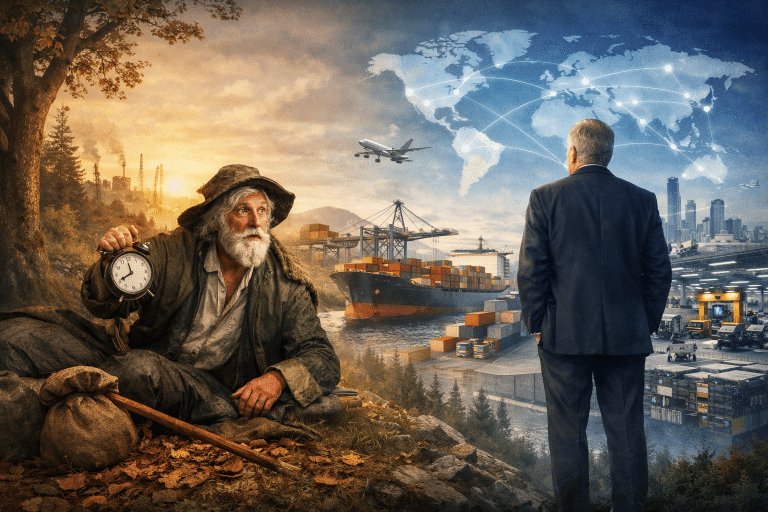
He Went to Sleep in One World and Woke Up in Another
In Washington Irving’s classic American short story, Rip Van Winkle fell asleep and missed a revolution. Our world of supply chain disruption tells a similar tale.
Let’s call that version Rip Van Supply Chain Disruption. Or just Rip for short.
For 45 years, I (Rip) lived inside supply chain operations.
Over the last few years, I stepped back from running supply chains day to day. I focused on building Tompkins Ventures, a company centered on entrepreneurship and matchmaking – with a heavy emphasis on supply chain.
I didn’t leave the field. But I did change my vantage point.
Last year, I stepped back into the operating side as chairman of Tompkins Solutions, the company I “refired” from during the pandemic.
And one thing is clear: this is not the same environment.
When Rip last looked closely at operations, the trajectory was clear. Automation was advancing. Systems were improving. Networks were getting more efficient. Optimization still ruled.
Now, as I’ve been saying for years, disruption is the new normal.
Supply chain disruption isn’t something you can manage through and move past. It shapes decisions every day – where you source, how you move goods, how much risk you carry and how fast you can respond when conditions shift.
The system didn’t stop working. But it started operating under different conditions.
Rip didn’t wake up behind.
He woke up in a world that no longer runs the way it used to. Globalization has transitioned into ReGlobalization – a global trading system shaped by nearshoring, friendshoring and reshoring.
And a lot of organizations are still catching up.
Supply Chain Disruption Ended Steady State
For a long time, I helped build global supply chains on the simple assumption that tomorrow would look a lot like today.
Take procurement as an example.
In a globalized world with few trade barriers, you found the lowest-cost producer and built volume with that supplier. You aligned your production schedules and locked in transportation.
Then you focused on improving efficiency – taking cost out, tightening the flow of goods, refining the model year after year.
It worked.
If you sourced from China from the early 2000s to the late 2010s, you could expect relative stability. Lead times were predictable. Costs moved, but not violently. The system rewarded scale and consistency.
That was steady state.
For the last few years, that model has broken down.
I noticed more disruption in the market even before the COVID-19 pandemic. Tariffs started to change economics overnight. Trade policies redirected global shipping.
Customer demand for goods and services changed faster than manufacturing processes could adjust.
Formerly reliable suppliers became points of failure with little warning.
Supply chain resilience became as important, or even more important, than that lowest-cost option. Low cost doesn’t matter if you have no inventory to deliver.
For supply chain pros, the primary question became, “How do we prepare for potential disruptions?”
That is a different way of thinking.
It requires cross-functional decisions across sourcing, transportation and operations. And it requires planning for more than one outcome.
Steady state allowed you to optimize a single path.
Supply chain disruption forces you to prepare for several.
That shift carries directly into how you design supply chains.
Optimality Is Out. Optionality Wins
Some organizations are already building optionality into their supply chain modeling and testing alternative suppliers that they can activate in real time.
Others still follow traditional network design processes.
That’s where you might concentrate production in one country, feed a small number of distribution centers and move goods through the most efficient routes. The math worked. The model showed clear savings.
And once you reached the lowest total landed cost, you didn’t revisit the model often.
And that was the point. An optimal network is stable by design.
Today, that same approach creates the risk that you won’t be able to deliver to customers during the next (inevitable) supply chain disruption.
The “best” supplier can become unavailable. The “lowest-cost” country can become the highest-risk overnight.
And the “most efficient” transportation route can shut down with little notice.
And when that happens, the model doesn’t help you.
Because you need resilient supply chains, which require multiple alternatives for sourcing, production and delivery – optionality.
That changes the design question.
That leads to different decisions.
Instead of one primary supplier, you qualify a second and a third, even if they cost more. Companies need to trim the waste from long qualifying periods – it shouldn’t take three years to find a new supplier.
Instead of one production location, you look at multiple regions across global supply chains. You build scenarios tied to changes in customer demand, cost and risk instead of relying on one fixed plan.
None of that looks optimal on a spreadsheet.
Optionality gives you the ability to move – to shift volume, adjust production schedules, reroute the flow of goods and respond in real time.
That performs better in the real world. While you’re delivering to your clients, competitors scramble to find capacity. They pay premiums and miss commitments.
Cost Still Matters. It Just Doesn’t Lead.
By this point, most leaders understand that cost alone doesn’t carry the decision.
The harder question is what replaces it.
Take inventory.
For years, you aimed to hold as little inventory as possible. You reduced working capital, improved turns and pushed anything that wasn’t immediately needed out of the system.
But what worked when supply was reliable breaks when it isn’t.
When it comes to finished goods sitting in a warehouse, most companies can adjust.
The bigger problems sit upstream. A single missing component or raw material that doesn’t arrive. Or a part you never dual-sourced because it didn’t justify the effort.
Those problems stop operations and quickly change the cost conversation.
Inventory didn’t become cheap. But supply chain disruption increased downtime – making the cost of being wrong more visible and more expensive.
When you lose production, you miss shipments. Or you pay extra to expedite freight. You pay for idle labor. And customers start looking for alternatives.
Those costs don’t show up in the original model. But they show up in the business.
Supply chain leaders must shift their decision-making. You still manage inventory and care about working capital.
But you secure some items for continuity instead of managing for efficiency. You evaluate some suppliers on reliability and access, not cost.
The same shift applies in transportation. Instead of chasing the lowest rate, leading companies are securing capacity. Managed transportation providers bring carrier networks that go eight or nine layers deep – giving you options when primary capacity tightens.
Don’t get me wrong, cost reduction didn’t go away.
It just stopped being the lead driver.
And that shift extends beyond operations into how companies structure their global networks.
ReGlobalization Changes the Map – and the Math
Hence the era of ReGlobalization, where you redesign global supply chains for control and responsiveness.
Consider what we’ve seen across the Tompkins Ventures network in the last few years. Manufacturers that once sourced heavily from China are making multiple moves, not one.
They’re nearshoring production – Mexico is often the first move – to serve North America faster. They are reshoring a portion of high-value or sensitive production to the U.S. for control. And they are adding friendshoring partners in aligned countries to reduce geopolitical risk.
Nearshoring cuts lead times and reduces reliance on long, fragile trade lanes.
Reshoring improves control, quality and responsiveness when it matters most.
Friendshoring aligns supply chains with countries less likely to disrupt trade for political reasons.
But the real shift is not any one of those moves.
It’s how leaders think about the network.
For years, supply chains were built around a center of gravity. One primary sourcing region. One dominant production base. Everything else fed into it.
That model concentrates risk.
ReGlobalization breaks that apart.
Instead of one node, you build several. You build access, which minimizes dependence. And your maps become flexible, not fixed.
With ReGlobalization, the world becomes your supply depot – but only if you can operate across it.
That requires more than suppliers in different countries. It requires relationships, infrastructure and the ability to shift volume when conditions change.
It requires a deep, global network – the kind of ecosystem we have built through Tompkins Ventures.
These strategies give companies something most lacked five years ago: the ability to move.
The Advantage in Supply Chain Disruption
Rip Van Supply Chain Disruption is not trying to catch up. He’s trying to figure out what matters now.
That’s the position a lot of organizations find themselves in. They’re making decisions with incomplete information, building optionality into their networks and adjusting as conditions change.
True supply chain leaders know they won’t get it perfect. But they will move with purpose, building ReGlobalized supply chains that put their companies in a stronger position.
If you’re sorting through those decisions – where to place capacity, how to build optionality, how to operate across a changing global map – reach out. We’re working through those same questions every day.
Because in this environment, the advantage goes to the companies that move – and keep moving.
Related Reading
- Part II: Systems Changed While Rip Van Supply Chain Slept
- Part III: Rip Van Supply Chain Wakes Up to New Execution Models

Jim Tompkins, Chairman and founder of Tompkins Ventures and Tompkins Solutions, is an international authority on designing and implementing end-to-end supply chains. Over five decades, he has designed countless industrial facilities and supply chain solutions, enhancing the growth of numerous companies. Jim earned his B.S., M.S. and Ph.D. in Industrial Engineering from Purdue University.