
From Planning to Execution, the Model Has Shifted
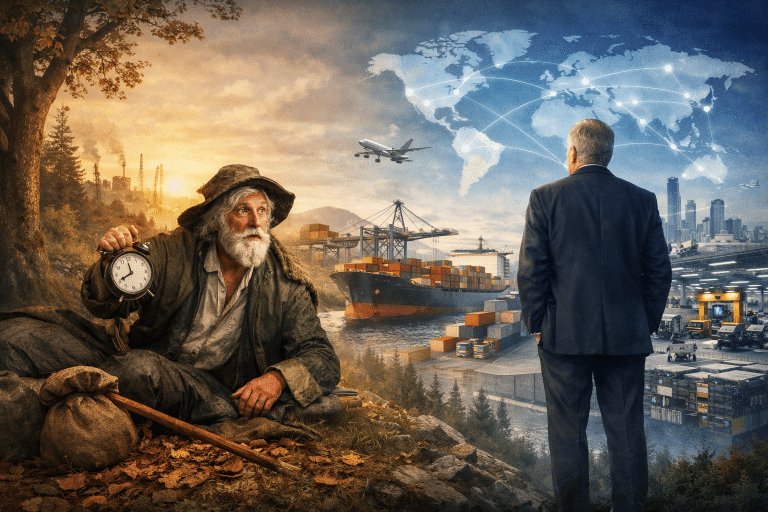
When we last left Rip Van Supply Chain, he had woken up to a completely different world.
Disruption became the environment. Globalization gave way to ReGlobalization.
Now, in the second of this three-part series, Rip discovers that the systems underpinning his new supply chain world have changed as well.
If you recall, I stepped away from running supply chains day to day to focus on building Tompkins Ventures. My perspective shifted from operations to entrepreneurship and matchmaking.
When I rejoined Tompkins Solutions last year, I realized that the world had changed, which I covered in my previous blog. Today, I’ll focus on how the systems changed. And next week, I’ll detail how what you see on the floor and in organizations differs.
For example, network planning systems have evolved into network decision orchestration. And transportation decisions have moved past the lowest rate. In the past, control towers provided visibility across supply chain systems. The next step is turning that visibility into coordinated action.
Artificial intelligence, especially generative AI and agentic AI, drives much of this system change. And that’s the crux of it all – AI is shifting from a set of tools to an operating system.
Network Planning Becomes Decision Orchestration
Start with network planning.
For years, we worked to build and run the most efficient network.
Most models relied on averages. Average demand, transportation cost and flow. You ran the math, selected the lowest-cost configuration and moved forward.
But averages hid how the system actually behaved.
Demand doesn’t show up evenly. It moves by season, by region and sometimes all at once. Transportation doesn’t stay fixed. Capacity tightens. Costs shift. What looked balanced in a model starts to drift in execution.
That worked back then. After all, we would deliver overall cost reductions of 7-15% and improve service levels by 20–30%.
In Rip Van Supply Chain’s new world, artificial intelligence has opened up new frontiers, allowing network planners to integrate demand planning and transportation.
We’ve seen this play out in real networks.
A company models its footprint and lands on five distribution centers as the right answer. On paper, it works.
But in the real world, service levels slip and costs increase.
Now, the Tompkins team uses AI to model demand variability and actual flow patterns. This approach allows us to model how the system actually moves. We can solve facility placement, inventory positioning and transportation together instead of in sequence.
That changes the answer. In one case, a four-node network performed better. Fewer facilities, but stronger consolidation, cleaner flows and lower total cost to serve.
Service improves – often into the 30-40% range – because inventory aligns with real demand. Costs come down – sometimes by as much as 25% – because flows consolidate instead of fragment.
But better design doesn’t guarantee execution.
The system still has to run.
In Transportation, the Lowest Rate Is Not the Lowest Cost
Transportation will test any system design.
Despite that, for years, many organizations treated transportation as a procurement exercise. Run an RFP, negotiate rates, lock in carriers.
That produces a number, not necessarily performance.
Because the lowest rate only works when the system behaves the way the model assumed. When demand shifts, capacity tightens or inventory sits in the wrong place, that “lowest rate” becomes the most expensive option in the network.
You see it differently in B2B and B2C environments.
In B2B networks, it shows up in inconsistency. Loads that should move truckload shift to LTL. Routing guides drift. Spot market usage becomes routine.
In B2C networks, the pressure comes from scale. Parcel costs rise quickly, and small changes in demand or inventory placement ripple across thousands of shipments.
In both cases, transportation is not the problem.
It is the signal.
A Transportation Performance Assessment can reveal those signals early.
We use it to understand how the system actually behaves – lane by lane, mode by mode, decision by decision. It shows where your planning is fragmented, your carrier mix creates risk and where you are missing consolidation opportunities.
From there, leadership can make structural decisions with clarity: centralize planning, reconfigure the carrier mix, upgrade or replace a legacy TMS, outsource to a managed transportation service provider, evaluate a private fleet.
In some cases, it could point toward a complete network design.
In others, your network is fine – you just need better transportation.
Either way, a modern TMS then executes those decisions – consolidating freight, sequencing tenders, adjusting routes in real time and providing visibility at the lane level.
Transportation will prove whether those systems work as intended.
Control Towers Become Command Centers
Control towers gave supply chain leaders visibility.
They showed where shipments were, flagged delays and helped teams react. That was a step forward.
But visibility alone doesn’t change outcomes.
Seeing a disruption is not the same as preventing it or redirecting around it. Too many organizations still operate this way – watching the system and responding after the fact.
That model has run its course.
The next step is a command center.
A command center connects data across the network and turns it into direction. It coordinates activities – adjusting flows, reallocating inventory and rerouting transportation as conditions change.
It operates as a digital backbone.
Data from carriers, facilities, inventory systems and external signals comes together in one place. From there, analytics and AI move beyond highlighting issues. They recommend actions and, in some cases, execute them.
The network no longer waits for the next planning cycle. It adjusts as conditions shift.
Control towers helped you see the system.
Command centers help you direct it.
And that only works if the system can keep up.
AI Shifts from Tools to an Operating System
Keeping up requires adopting AI, not just adding tools.
Companies use it to write content, analyze data or automate a task. Useful, but limited. Because they haven’t changed the underlying system – the way they actually do work.
That’s adding tools, not true adoption.
Value shows up when AI moves into the center of the system – when it drives decisions as an operating system.
Instead of people pulling data from multiple systems and deciding what to do next, the system connects those inputs and determines the next action. Planning, transportation and execution stop operating in sequence and begin operating together.
And that’s how these shifts come together.
Network design improves because demand and flow patterns are evaluated continuously. Transportation improves because decisions adjust as conditions change. Command centers work because the system can process, recommend and act.
This doesn’t remove people from the process. It changes their role inside it.
Leaders still set direction. They define trade-offs. AI systems then carry those decisions forward – consistently, quickly and at scale.
Rip Is Back on His Feet – Now He Has to Operate
Rip Van Supply Chain isn’t trying to relearn what he already knew.
He’s trying to operate in a system that doesn’t behave the same way.
The world changed. The systems changed. Now he has to make decisions inside them.
If you’re seeing that in your own operations, it’s worth a conversation about what’s actually happening inside your network, transportation and systems – and what to do next.
Because Rip doesn’t have the luxury of another nap.
In the final part of this series, I’ll cover what he sees when he walks the floor – how the work itself has changed, and what that means for the people, processes and technology running today’s supply chains.
Related Reading
- Part I: Rip Van Supply Chain Disruption Missed the Shift
- Part III: Rip Van Supply Chain Wakes Up to New Execution Models

Jim Tompkins, Chairman and founder of Tompkins Ventures and Tompkins Solutions, is an international authority on designing and implementing end-to-end supply chains. Over five decades, he has designed countless industrial facilities and supply chain solutions, enhancing the growth of numerous companies. Jim earned his B.S., M.S. and Ph.D. in Industrial Engineering from Purdue University.
This guide explained everything clearly.