
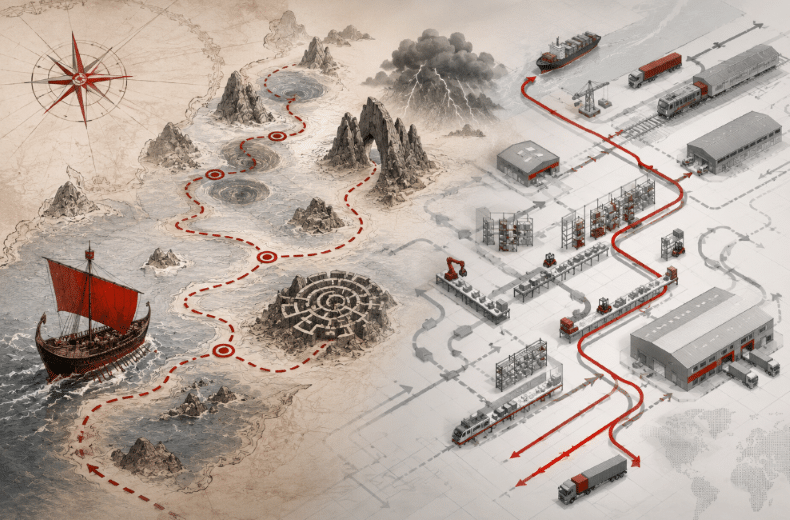
Odysseus Had His Monsters. Intralogistics Has These
Sometimes, warehouse design reminds me of Greek mythology.
Odysseus spent 10 years returning home from the Trojan war. He knew how to get back to Ithaca and had the skill to get there. But sirens, monsters and gods forced detours, delays and backtracking.
For 50 years, I’ve walked into warehouses and found the same myths, the same assumptions, the same avoidable problems. I’ve spent a lifetime navigating them.
While a new retelling of The Odyssey hits theaters next month, sadly, they won’t make a movie focusing on warehouse design. I can see why – my obstacles aren’t monsters; they’re myths that have survived for decades. For example, many companies think all they need more automation. Some think only massive operations benefit from warehouse redesign. Or they think acceptable performance means there isn’t a problem.
And they think improvements cost too much.
Those assumptions sound reasonable. They also cost companies money every day.
And none of them address the real issue: flow. Warehouse design is all about intralogistics – how inventory, information, equipment and people move through the facility.
When intralogistics works, operations tend to run smoothly. When it doesn’t, companies often spend money addressing symptoms instead of fixing underlying causes.
In my latest intralogistics research, I examined seven misconceptions that continue to shape warehouse design decisions. Some myths seem harmless. None of them are.
Myths 1 Through 4: Automation Solves Everything
Four of the seven are the same myth in different clothes.
One says every operation should automate as much as possible. Another says you have to do it all at once. A third claims automation means giving up control. A fourth says automation eventually eliminates people.
Different assumptions. Same flawed logic.
I’ve spent much of my career evaluating automation technologies. Conveyors, autonomous mobile robots, goods-to-person systems, warehouse management systems (WMS) – I’ve seen what works and what doesn’t. Automation can improve throughput, accuracy and order fulfillment.
But I’ve come in too many times after companies have installed automation on top of broken processes. They wonder why performance doesn’t improve – or even tanks.
That’s because automation follows process – not the other way around.
If inventory sits in the wrong locations, robots don’t revisit incorrect slotting decisions. If replenishment creates bottlenecks at the pick face, no WMS unclogs that blockage.
In many cases, automation simply surfaces problems that were already there. That’s not a reason to avoid automation. Fix the underlying process first – then decide what technology actually earns its place.
The other myths in this group don’t hold up much better. Modular automation has made phased implementation standard practice. A good implementation team can add capacity to a live facility without shutting it down.
And far from reducing visibility, modern systems give managers real-time inventory data and material flow dashboards they never had with manual processes.
As for replacing people – the distribution centers I’ve worked with don’t run without them. Automation changes how people work. It doesn’t make them unnecessary.
Don’t start warehouse design by selecting a technology. Start with understanding how work actually moves through the facility – and build from there.
Myth #5: Warehouse Design Only Matters for Large Operations
I hear this misconception from small and midsized organizations all the time.
Sophisticated warehouse design is for major distribution centers. We aren’t large enough to worry about that yet.
You’re wrong.
Poor flow creates problems regardless of facility size. A smaller operation can still suffer from excessive travel, bad slotting, congestion, inventory inaccuracies and inefficient use of labor. Smaller facilities face these issues and have fewer resources to absorb the excess costs.
I have helped companies in relatively modest facilities improve throughput dramatically without adding space, labor or automation.
For example, perhaps you cannot afford an army of robots for your regional distribution/fulfillment center. But better internal slotting, a basic WMS to track inventory and conveyor segments to reduce walking all improve efficiency.
And as technology costs decrease, artificial intelligence can help operations of all sizes. Affordable AI-powered slotting tools can analyze pick frequency and inventory velocity – no enterprise budget required.
Vendors have expanded entry-level systems tailored for smaller or midsized warehouse operations. A single aisle of automated storage and retrieval systems (AS/RS) can improve the flow of goods. Smaller distributors can improve operations without risking a seven-figure implementation.
The principles of good warehouse design don’t change with the size of the building. Only the excuses do.
Myth #6: If It Isn’t Broken, Don’t Fix It
This may be the most expensive warehouse design myth of all – because it prevents any decision at all.
The losses compound quietly, and nobody ever sees the invoice. From a distance, your operations look fine. Orders ship. Customers receive product. No one seems to be loafing.
But after I spend time on the floor, I see a different picture. Employees aren’t loafing because they’re too busy. They walk farther than necessary and touch inventory multiple times. Supervisors spend their days chasing exceptions.
None of this triggers an alarm. But all of that wasted time, movement and workarounds become standard operating procedure.
Then companies expand facilities because they think they’ve outgrown their space. They carry excess inventory because they couldn’t trust their own internal execution. Labor costs climb because employees spend overtime compensating for process problems.
Meanwhile, demand patterns shift and customer expectations rise. The operation that looked fine last year is quietly falling behind.
High-performing distribution centers don’t wait for something to break. They run regular analyses – using AI and WMS data to find bottlenecks, reoptimize pick routes and revisit inventory layout.
In competitive markets, the companies that continually refine their intralogistics pull ahead. If you stand still, you’ll eventually wonder what happened.
Myth #7: Warehouse Design Is Too Expensive
Most leaders ask what warehouse improvements will cost.
That’s a fair question. The better one is what poor warehouse design already costs.
Think of all the wasted time, movement and unnecessary facility expansions from Myth #6.
Now add inventory inaccuracies that kill your service in two ways. First, unexpected out-of-stocks mean you can’t fulfill orders. Second, your warehouses are overloaded with slow-selling merchandise.
I’ve worked with organizations that delayed warehouse improvements for years, treating them as optional spending. They paid far more through inefficiency than they ever would have spent fixing the problem.
The ROI math is more straightforward than most executives expect. An automated sortation system, for example, can reduce outbound sorting labor, eliminate missorted shipments and pay for itself within three to five years.
That’s a typical outcome.
Sticker shock comes from looking at the price tag in isolation. The real number to focus on is what doing nothing costs you every year.
Fifty Years In, the Myths Still Stand
Odysseus faced angry gods, a man-eating cyclops and enticing sirens. He made it home, but only after 10 years. I won’t spoil the movie ending by telling you more. But you likely already know – scholars estimate the original tale is about 2,700 years old.
I’ve only spent 50 years in warehousing and intralogistics. But I’m finding the same assumptions – technology before process, buildings before flow, visible costs while hidden ones compound.
Different monsters force different detours.
The good news is that none of these myths are hard to fix once you see them clearly. The problem is that most operations never stop long enough to look.
Which of these are still showing up in your facility? I’d like to hear about it.
Related Reading
- Intralogistics Is Where Your Supply Chain Performs – or Not
- The Right Facilities, the Right Real Estate
- Part III: Rip Van Supply Chain Wakes Up to New Execution Models

Jim Tompkins, Chairman and founder of Tompkins Ventures and Tompkins Solutions, is an international authority on designing and implementing end-to-end supply chains. Over five decades, he has designed countless industrial facilities and supply chain solutions, enhancing the growth of numerous companies. Jim earned his B.S., M.S. and Ph.D. in Industrial Engineering from Purdue University.