
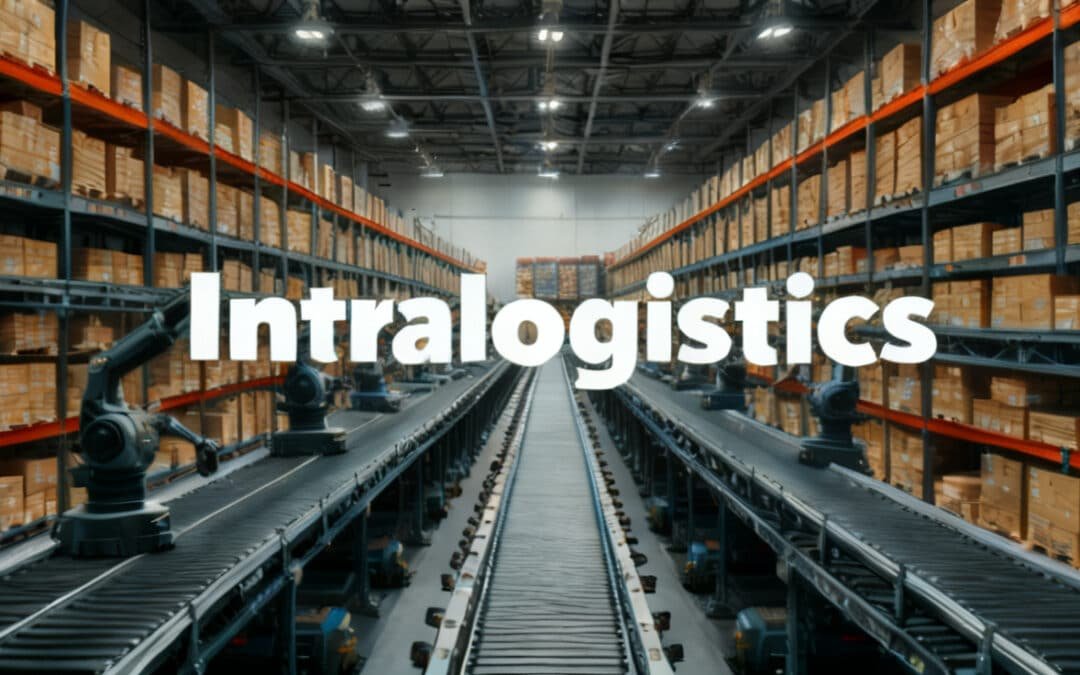
What Happens Inside Your Facility Drives Everything That Follows
Supply chain leaders focus so much on what happens beyond the warehouse that they often overlook intralogistics – what happens inside your four walls.
And I get it. Disruptions halfway around the world shut down operations and dominate headlines. Supply chains don’t function without transportation, sourcing and open trade lanes.
But the products you ship don’t move themselves once they reach your facility. Your warehouses must receive, store, pick, pack and ship every order.
That’s where intralogistics lives – and where I’ve spent decades.
If you can’t move goods, parts or raw materials through your warehouse, nothing else works the way it should – a point we explore more deeply in our latest intralogistics research.
Intralogistics ultimately drives performance.
What Intralogistics Actually Means in Your Operation
Intralogistics refers to moving and orchestrating goods inside your distribution center or fulfillment operation. It includes your employees and managers, the material handling equipment supporting them and the processes that connect everything.
Most companies don’t think about it that way.
They treat intralogistics as a supporting function. Something that needs to “work,” but not something that drives outcomes. They focus on what’s visible: transportation costs, supplier pricing, network footprint.
Unless they pay close attention, they miss critical areas that involve internal material transport; inventory and information management; and distribution/fulfillment center operations.
Internal material transport can involve forklifts, conveyor belts, automated guided vehicles, goods-to-person picking solutions (donor totes delivered to a workstation), pocket sortation or even manual cart moves.
Inventory and information management tracks stock levels, item locations and inventory movements in real time. IT systems (WMS, WES, AI) record every internal movement, update stock counts and manage replenishment and order fulfillment activities.
It also includes weighing, cubing and dimensioning equipment, with systems that ensure digital information mirrors the physical movement of goods.
These processes run across the entire facility – from goods receipt and quality inspection, to putaway, order picking and packing.
From there, facilities stage and dispatch outbound orders.
It also includes related tasks such as reverse logistics – handling returns in-house – and value-added services like kitting or light assembly.
The goal is simple: faster execution, fewer mistakes and a flow of goods that actually works.
You’re Already Measuring Intralogistics – Whether You Realize It
Breakdowns in those processes don’t stay on the floor. They show up in the numbers – in throughput, accuracy and customer service.
Longer pick paths and constant searching slow down order cycle times. Extra touches and rehandling drive down labor productivity. Inventory that’s “in the system” but not where it should be turns into accuracy issues and missed shipments.
You don’t need a new dashboard to see it. You’re already tracking it:
- Order cycle times
- Labor productivity
- Inventory accuracy
- On-time, in-full delivery
Those numbers directly affect order accuracy and overall service performance. Sadly, leaders often don’t connect these metrics back to what’s happening inside the facility.
I’ve seen companies expand their footprint when they didn’t need to. Operations didn’t flow, so they attributed bottlenecks to a lack of capacity. But if they had fixed the flow, the same facility could have handled more volume. And they could have saved money.
In other cases, warehouses carry more inventory than necessary because they couldn’t rely on their internal processes. The system couldn’t move product fast enough or accurately enough, so they compensated with more stock. Again, that’s money wasted.
And I’ve seen labor costs climb for the same reason. Companies add more staff to keep up with inefficiencies that shouldn’t exist in the first place.
That’s what happens when you overlook intralogistics – you react to symptoms instead of fixing the cause.
By optimizing space utilization and workflow, your operations can defer expensive expansions and reduce inventory carrying costs.
And all of it comes back to how work gets done inside your facility.
If It Doesn’t Work Inside, Nothing Works Outside
Clearly, intralogistics deserves the same attention as other parts of supply chain management.
Many supply chain problems don’t start with complex issues like transportation, geopolitical disruptions or tariffs.
They start with simple things: poor internal movement, too many touches, too much backtracking, too much time spent moving product instead of fulfilling orders.
If you’re seeing these problems in your operations, I’d be interested to hear where intralogistics is breaking down.
Related Reading
- Why Your WMS Fails at Warehouse Execution
- Why Intralogistics Deserves a Seat at the Strategy Table
- Many Won’t Recover a Dime from IEEPA Tariffs

Jim Tompkins, Chairman and founder of Tompkins Ventures and Tompkins Solutions, is an international authority on designing and implementing end-to-end supply chains. Over five decades, he has designed countless industrial facilities and supply chain solutions, enhancing the growth of numerous companies. Jim earned his B.S., M.S. and Ph.D. in Industrial Engineering from Purdue University.