
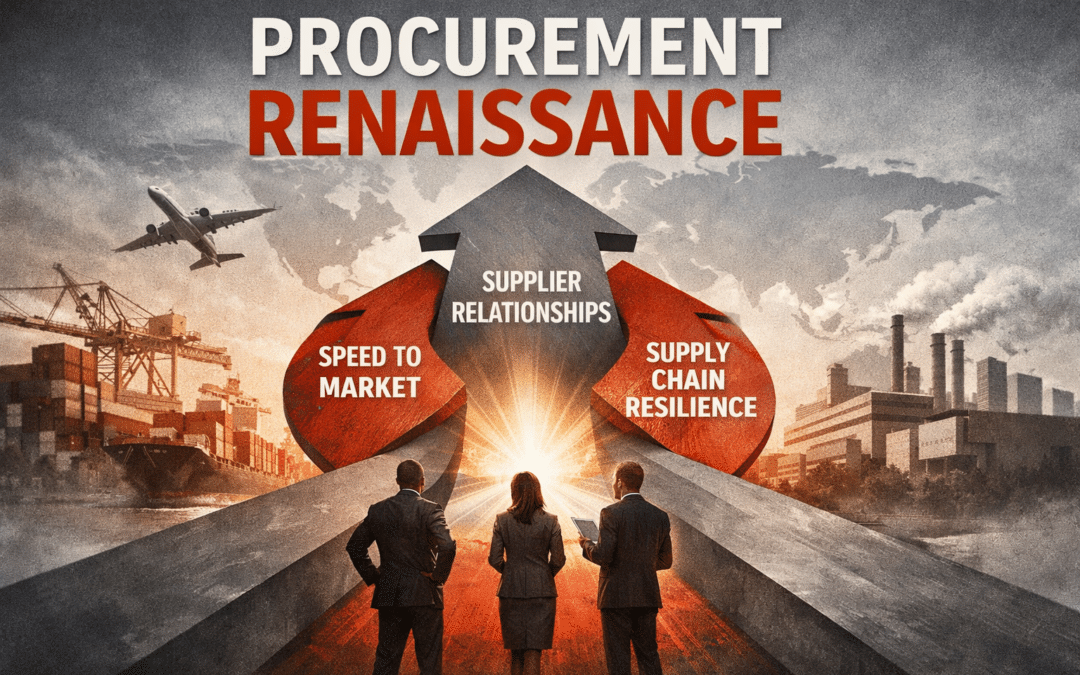
Speed, Supplier Relationships and Innovation Matter More Than Pennies
For most of the last 40 years, procurement, like supply chain, has had a clear mandate to cut costs. Save the company a few bucks. Negotiate a few cents off unit price. Then get your promotion.
That world is gone.
We are in the genesis of a procurement renaissance. Our world of perpetual disruption has pushed procurement to the front line of the business. Procurement is often the lever that unlocks innovation and value across the enterprise.
Yes, some leadership teams still only think cost reduction. Those C-suites are underestimating one of the most powerful levers in their business.
Because in the era of perpetual disruption:
- Speed to market determines winners and losers.
- Supplier relationships drive innovation.
- And the teams responsible for getting the organization what it needs must think very differently.
Let me explain.
Procurement Moves from Buyer to Strategic Navigator
The procurement renaissance starts with a mindset shift.
Persistent trade turmoil forces companies to think ahead, not react after the fact. That means multi-sourcing strategies, geographic supplier diversification and real scenario planning. Procurement leaders must act as risk forecasters, not just buyers.
That focus dramatically expands procurement’s role to span strategy, technology and leadership. Procurement teams must manage long-term relationships and create stability in unstable markets. They are getting help by adopting AI-driven forecasting tools, compliance automation and digital twins.
For the procurement renaissance, professionals must be at the nexus of building resilience, optionality and flexibility into global supply chains.
That’s a far cry from buying widgets at the lowest price.
Obviously, much of procurement involves finding suppliers, negotiating and writing contracts. Tariff volatility has also changed how the discipline writes and uses those contracts. Today, contracts routinely include tariff-adjustment clauses, index-based pricing and HS-code reviews.
In fact, last year, more than 90% of companies embedded such clauses into supplier agreements. Those moves are one way to protect the company’s profit-and-loss statement.
This transforms contracts from administrative paperwork into operational assets primed for C-suite conversations.
When trade policy can swing margins overnight, procurement’s decisions belong in the boardroom alongside finance and legal.
And that’s where leaders of the procurement renaissance must become storytellers. They must explain in language that the C-suite understands how sourcing decisions protect margins and reduce risk. They must explain that procurement adds supply chain resilience.
That shift, from transactional manager to trusted advisor, defines the future of procurement.
From Cost Control to Innovation Engine
Another big shift involves procurement’s ability to accelerate innovation.
Here’s an example. At a recent Tompkins Ventures Business Partner forum, one partner detailed a recent conversation with a CEO and his executive team. The head of sales said, “We’re solving today’s market challenges with yesterday’s products.”
That statement points directly to where procurement can create value. Many C-level executives know their organizations have ambitious ideas. They see the gaps in the market, and they know they can fill those gaps.
But they can’t bring a product to market in less than three years.
Finding the right partner can bring that time down to as little as six months.
With the right partners, your organization connects with abilities beyond internal capabilities. Your partners can iterate faster, and you can manage the risk at arm’s length.
Speed to market moves from an operations problem to an ecosystem problem.
Suppliers constantly innovate with new materials, formulations and manufacturing methods. They will give their best ideas to their customers of choice. But are they going to share their best ideas with you or your competitors?
Face it, if your team treats every engagement as a transactional request for proposal, you lose. Suppliers won’t work with you if they’re going to soon lose a contract over 2 cents a unit.
When you value suppliers and build trusted relationships, you find real opportunity. Properly structured supplier collaboration can reduce product development timelines from years to months.
That doesn’t happen from cutting corners. That happens because organizations align governance, demand forecasting, early cost modeling and factory onboarding from the beginning.
That is a profound shift from shaving pennies to shaping outcomes.
When Everyone Has AI, Relationships Matter More
Those relationships matter even more in a world replete with AI. Artificial intelligence can compare vendors, analyze spend and recommend alternatives instantly.
In fact, Tompkins Ventures has an AI-enabled diagnostic tool that acts as a high-velocity X-ray for procurement operations. The tool can ingest massive data sets and produce a clear executive roadmap in about 30 days.
The roadmap reveals why margins are drifting and where EBITDA is actually leaking.
But what you do with that data depends on trust. And artificial intelligence cannot replace human trust. You could have a 5% value leakage in freight, a governance gap in logistics or a need for a complete supply chain overhaul.
That requires an ecosystem. The next generation of high-performing organizations will combine analytics with curated, strategic supplier networks. One Tompkins Ventures Business Partner called it augmented relationship management.
And over the last few decades, a lot of that human touch eroded during the drive for lowest piece price.
Endless RFP cycles weakened depth. Managing contracts replaced building partnerships. Indirect procurement became automated and distant. The pool of trust got shallow.
AI can give you great analytical answers. But it can’t make the choice for you, expand your network or handle personal relationships with your suppliers.
What Happens When We Treat Procurement Like It’s 2015
Still think the C-suite should relegate procurement to a lower-level function?
Let’s review. Ignoring the procurement renaissance exposes companies to following risks:
- Margin erosion: Without a renaissance mindset, tariff increases and supplier price hikes go straight to the bottom line. Margins compress quickly when companies fail to renegotiate contracts or embed tariff protections.
- Sourcing paralysis: Waiting for certainty in volatile markets leads to inaction. The companies that hesitate miss opportunities to nearshore, reshore or diversify suppliers.
- Lost negotiation power: By not strategically empowering procurement, businesses miss windows to lock in favorable long-term agreements. Competitors who act decisively gain stability and leverage.
- Compliance and reputational risk: Tariffs bring changing rules of origin, classifications and documentation. A transactional procurement function is more likely to miss something – and pay for it later.
- Innovation bottlenecks: Procurement is the gateway to new suppliers, materials and technologies. Keeping it tactical slows adoption of automation, sustainability initiatives and advanced analytics.
- Boardroom blind spots: Treating procurement as back-office work deprives executives of critical intelligence about supply chain risk. The C-suite makes decisions without the full picture.
- Competitive disadvantage: In industries where competitors elevate procurement, laggards face higher costs, slower response times and weaker resilience.
Ignoring the procurement renaissance is like sailing into a storm without a navigator. Costs rise. Risks multiply. Opportunities pass by.
Instead of scrambling every time a policy changes, procurement must orchestrate resilience across the enterprise. That means coordinating suppliers, finance, operations and compliance through a unified system.
Value retention matters just as much as value creation. We have seen too many “savings” disappear during execution. A true procurement renaissance requires governance, accountability and performance systems.
That way, savings don’t just look good on a slide – they stick.
The C-Level Conversation Has Changed
At its most basic, a business makes something and moves it to a customer.
To do that, it needs components, raw materials, intermediate parts and finished goods. For decades, we treated the function that secured those inputs as a cost-control mechanism.
That thinking is outdated.
The original Renaissance was a period when disciplines converged – art, science, engineering and commerce informing one another. It produced the Renaissance man: versatile, analytical and creative at the same time.
The procurement renaissance demands the same blend.
In this procurement renaissance, the function has become the commercialization layer of the enterprise. It sits at the intersection of ideas, finance, operations and the physical world. It balances innovation with cost, speed with risk, resilience with margin.
When trade policy can swing margins overnight, when supplier innovation determines how fast you reach market, when a single sourcing decision can protect or erode EBITDA – those decisions belong in the boardroom.
Our vision for the future of procurement is clear. Procurement orchestrates an ecosystem of partners. The discipline leverages digital tools for clarity and speed. It drives innovation across the enterprise.
Procurement leaders act as risk managers, contract strategists and translators – connecting sourcing decisions directly to business outcomes.
That is the procurement renaissance we believe in – and the one we see taking shape right now. The companies that embrace it will not just defend margins. They will unlock growth, build resilience and gain an advantage in an uncertain world.
And the ones that don’t?
They will keep reacting while their competitors widen the gap – and rewrite the rules.
Related Reading
- How Tompkins Ventures Procurement Simplifies Global Sourcing
- 5 Reasons Procurement Can Be the Tip of Your Spear
- Thank Tariffs for Forcing Supply Chain Excellence

Jim Tompkins, Chairman and founder of Tompkins Ventures and Tompkins Solutions, is an international authority on designing and implementing end-to-end supply chains. Over five decades, he has designed countless industrial facilities and supply chain solutions, enhancing the growth of numerous companies. Jim earned his B.S., M.S. and Ph.D. in Industrial Engineering from Purdue University.