
The Right Word Is Renaissance – Something the World Has Never Seen
Would you call the iPhone a better rotary phone? Then why are people talking about the reindustrialization of U.S. manufacturing?
Reindustrialization is the wrong word. And the words we choose shape the strategies we build.
Reindustrialization implies going back. Back to labor-intensive assembly lines, cost-minimization and the predictable, steady-state factories of the 1950s and 1980s.
That world is gone. We are not going back to it.
What U.S. Manufacturing Once Was – and What It Can Become
The nostalgia around U.S. manufacturing isn’t baseless.
In 1953, manufacturing accounted for roughly 28 percent of U.S. GDP and employed about 32 percent of American workers. A factory worker with a high school diploma could buy a house, raise a family and retire with a pension. That was real, and it mattered enormously.
Fast forward to today, and the Bureau of Labor Statistics reports that manufacturing accounts for 10 percent of U.S. GDP and employs 13.1 million workers. The Information Technology and Innovation Foundation, citing Bureau of Economic Analysis data, put manufacturing’s GDP share at 10.2 percent in 2024 – down from 11.3 percent in 2012. Those numbers fuel the reindustrialization argument.
But reindustrialization romanticizes the wrong era.
Because the Manufacturing Renaissance will not recreate those postwar jobs. It will create better ones. Engineers, automation specialists, AI technicians and advanced manufacturing operators will earn more than the assembly line workers of the 1950s ever did.
That knowledge-intensive (not labor-intensive) workforce will have better working conditions and stronger long-term prospects. U.S. manufacturing’s future will not resemble another Rust Belt.
The postwar factory built the first American middle class. The Manufacturing Renaissance has the tools to build a stronger one.
The distinction matters enormously for how companies invest, how schools train and how policymakers legislate.
A Renaissance Is a Leap, Not a Return
A renaissance is not a return. The original Renaissance did not revive ancient Rome. From the 14th to the 17th century, Europeans used Roman ideas as fuel for something entirely new. That is precisely the path the U.S. manufacturing industry must follow now.
The tools driving this renaissance are real and already in motion.
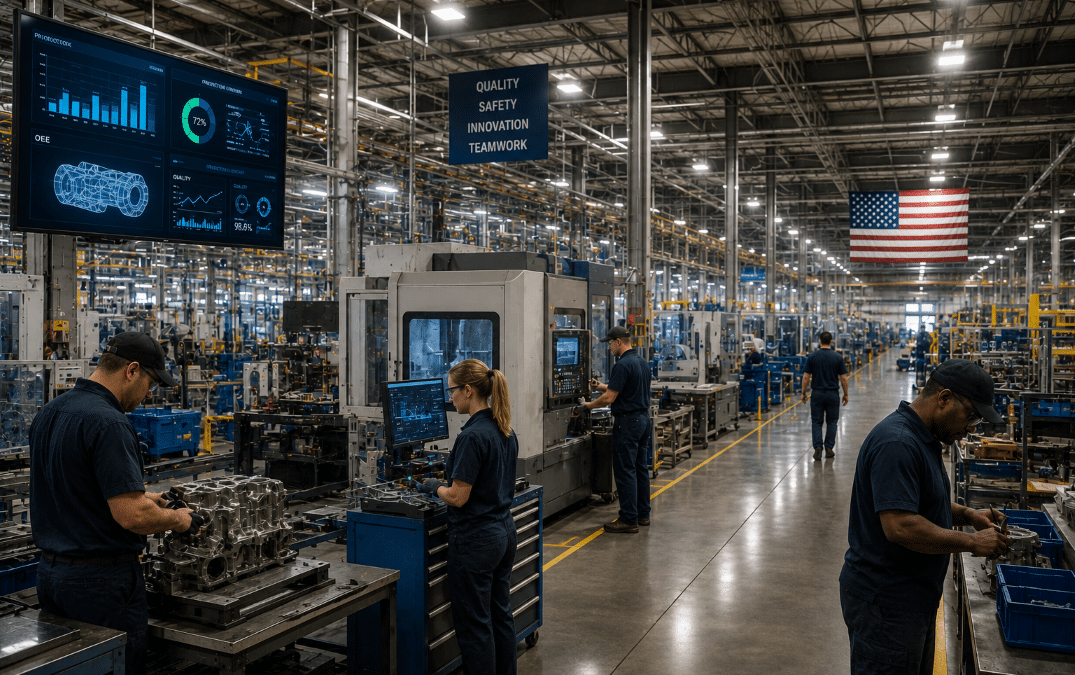
Artificial intelligence helps supply chain planners. Autonomous forklifts and mobile robots keep warehouses moving. Robotics-as-a-Service gives midsize manufacturers access to automation they could not previously afford.
Predictive analytics catch equipment failures before they happen. Smart factories adjust the production of manufactured goods as demand shifts.
This is not “re” anything. This is the next everything.
JIO Replaces JIT – and JIC
For decades, manufacturing’s operating mantra was Just in Time.
Three industrial engineering degrees from Purdue University drilled those principles into my head: Keep inventory lean. Trust your suppliers to deliver on schedule. Minimize slack in the system.
Those principles made sense in a stable world. They also made U.S. manufacturing dangerously fragile. When you optimize relentlessly for lowest cost, you strip out every buffer that might protect you when things go wrong.
COVID proved that. Supply chains built around labor arbitrage and single-source efficiency collapsed under the first serious stress test in decades.
Much of U.S. manufacturing responded with Just in Case – safety stocks, buffer inventory, redundant suppliers. Understandable. Also not the answer.
But neither JIT nor JIC captures where the best manufacturers are heading. The right model is JIO: Just in Options.
JIO means building production networks flexible enough to pivot sourcing, shift suppliers and adjust inventory as conditions change. Political fragmentation, climate disruption, tariff volatility, cyber risk – the next decade will generate disruptions we cannot fully predict.
Resilience is the only rational response. We can use our capital investments wisely, building enough optionality to respond quickly when disruptions arrive.
Reindustrialization does not capture that. A Manufacturing Renaissance does.
The Renaissance and ReGlobalization Are the Same Bet
I have written extensively about ReGlobalization. This strategy shifts from single-source global supply chains to diversified, resilient networks that span multiple regions.
ReGlobalization is smarter globalization. Nearshoring to Mexico, reshoring in the U.S. or friendshoring with ASEAN partners are not a retreat from global trade. They are investments in optionality. Global manufacturing remains important – after all, much of U.S. manufacturing relies on imported inputs.
The Manufacturing Renaissance is the domestic expression of that same logic.
New automation, workforce training and artificial intelligence are building digital infrastructure. Together, they represent a new operating philosophy built for VUCA – volatility, uncertainty, complexity and ambiguity.
Why the Language Matters
You may think this is semantic. It is not.
The words executives and policymakers use matter. Words determine what solutions they fund, what talent they recruit and what investments they make.
If we call this reindustrialization, we will build policies around bringing back old jobs and old factories. We will measure success by headcount, anchoring to a past that no longer exists.
If we call it a Manufacturing Renaissance, we will build policies around innovation, automation and resilience. We will measure success by competitiveness, adaptability and output per worker. We will build toward a future that can actually win.
My 50 years in supply chain have taught me that framing is strategy. Get the frame wrong and you get the strategy wrong.
U.S. manufacturing must not return to the past. We must build a new future – an intelligent, resilient, digitally enabled manufacturing nation. Let’s call it what it is – a Manufacturing Renaissance.
How is your organization developing its manufacturing strategy for the future?
Related Reading
- ReGlobalization – Redefining Global Supply Chains
- Packaging Solutions that Don’t Leave a Warehouse Mess
- Intralogistics Is Where Your Supply Chain Performs – or Not

Jim Tompkins, Chairman and founder of Tompkins Ventures and Tompkins Logistics, is an international authority on designing and implementing end-to-end supply chains. Over five decades, he has designed countless industrial facilities and supply chain solutions, enhancing the growth of numerous companies. Jim earned his B.S., M.S. and Ph.D. in Industrial Engineering from Purdue University.