
Leaders Who Harness Flexibility Will Thrive in Disruptive Times
I’ve written a lot about optionality over the last few years. Oil shocks, tariff wars, pandemics and AI breakthroughs have taught me that no single supply chain solution can protect a business for long.
That’s almost a clean break from my industrial engineering background. Purdue trained us IEs to optimize everything. And my teams and I spent decades optimizing supply chain operations across the globe.
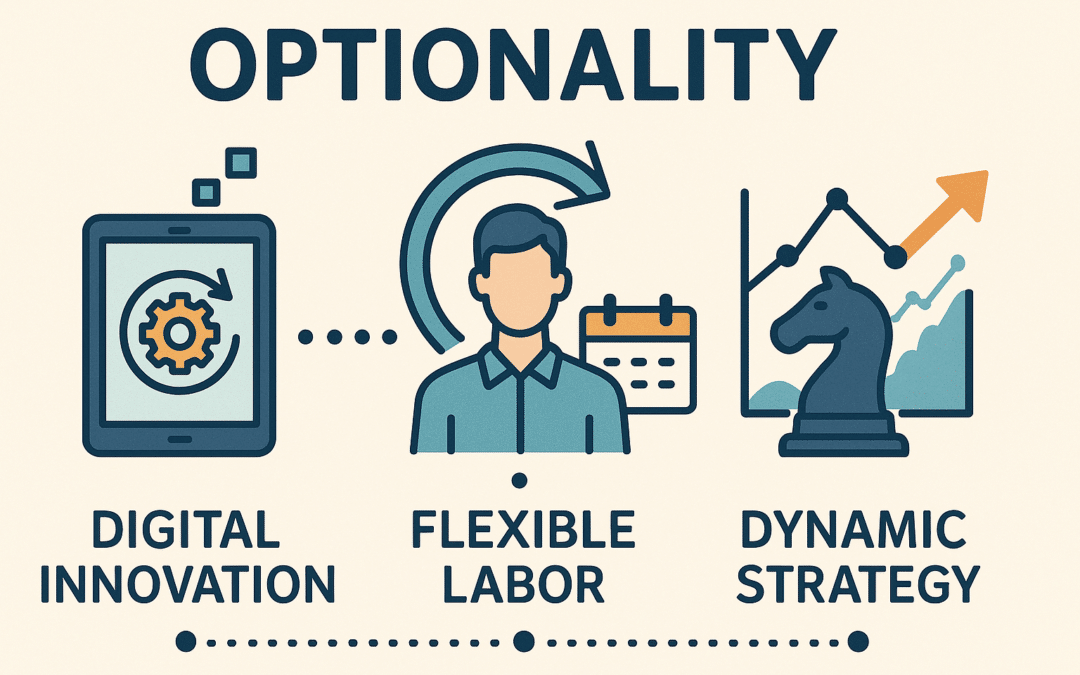
That’s probably why many people think “supply chain” when I mention optionality. But optionality encompasses so much more: it is a way to design and run a business that favors breadth of choices and the speed to pivot among them. In fact, optionality applies to every major business function. But for this blog, I’m going to concentrate on digital technology, workforce and operations, and strategic planning.
Of course, all of these touch on supply chain, because everything in business comes down to supply chain. Without supply chains, your customers get nothing.
Optionality is not redundancy for redundancy’s sake. It means cultivating a portfolio of viable paths and the agility to switch among them as conditions change. Success is measured not by how perfectly a system performs in steady state but by how gracefully it adapts when the ground shifts.
In a VUCA (volatility, uncertainty, complexity, ambiguity) world, the “best” option today may be obsolete tomorrow. The competitive advantage lies in sensing change, simulating alternatives and activating the right choice quickly. Let’s explore what that looks like across the enterprise.
Digital Enablement Transforms Technology into Action
In the digital age, optionality begins with information. Advanced analytics, Internet‑of‑Things sensors and artificial intelligence have transformed supply chains into glass boxes that reveal what’s happening in real time. These technologies deliver insights that let us pivot before disruptions cascade. True digital enablement can transform control towers to digital supply chain command centers.
These aren’t the dashboards of old. They are decision‑making engines that suggest viable alternatives – suppliers, routes or modes – when the unexpected occurs.
AI platforms can ingest data on tariffs, sanctions and social sentiment, then recommend shifting production before a policy change takes effect. Without digital enablement, the human brain cannot process the volume and velocity of data required to make these calls. Modern digital supply chain networks also automate data flows so that switching to an alternative partner becomes execution rather than negotiation. In short, digital optionality means investing in technology that expands our field of vision, accelerates response time and informs which options are worth pursuing.
Digital platforms also allow experimentation. By modeling how a 20% demand spike or a port closure would affect operations, leaders can test which options are truly viable.
Digital twins and simulation tools turn scenario planning from guesswork into evidence. They help you see where bottlenecks lie and how alternative suppliers or routes would perform under stress. In this way, digital optionality feeds directly into strategic planning, because it tells you which options deserve investment and which are better left on the drawing board.
Labor on Demand Offers Workforce and Operational Optionality
Optionality extends to people and processes. Demographic shifts and changing work preferences make it harder to rely on traditional hiring.
That’s why I advocate for flexible labor or “labor on demand.” When a warehouse needs to scale up for peak season, tapping into a pool of part‑time or gig workers can fill shifts without the expense of permanent hires. In one case, Tompkins Ventures partners staffed an entire facility in minimal time using labor on demand.
These workers wanted to choose their own hours through a flexible labor platform. A vast pool of employees want control over when and where they work. Tapping into that workforce can give your operation the agility to match supply with demand.
Cross‑training also builds optionality. A team member who can switch from picking to packing to equipment maintenance is more valuable during a disruption than a specialist confined to one task. Modular production lines that switch products quickly, micro‑fulfillment centers that serve urban customers and flexible automation that handles multiple tasks are examples of operational optionality.
Combined with flexible labor, these tools form a resilient model that can pivot quickly without overcommitting resources.
Even outside of warehousing, not every task requires a full‑time employee. Emerging platforms connect businesses with skilled contractors who want multiple income streams and control over their schedules. When you embrace this model, you expand your labor pool to access specialized skills on demand. Flexible labor fosters a culture of adaptability and reduces the time it takes to ramp up or down when market conditions change.
With Optionality, Plan B Is Just the Beginning
Clinging to a single plan is risky in a world of perpetual disruption. Optionality shifts the strategic mindset from optimization to adaptation.
Regular scenario planning can model how tariffs, pandemics, cyber‑attacks or demand swings might force change. Those results help you identify risks and map the triggers that would cause you to pivot. You establish multiple strategies and define indicators that signal when to enact each. Dynamic strategy optionality is not one plan but a set of plans with a playbook for when to switch.
Many executives prefer to “wait and see,” but waiting is not a strategy. Eventually, you must accept that uncertainty is part of the landscape and build options that allow you to thrive regardless of which scenario unfolds.
This requires continuous scenario planning. I sometimes joke that once you finish your ReGlobalization plan, you should start on your ReReGlobalization plan and then your ReReReGlobalization plan. The humor underscores a serious point: you must perpetually refresh your strategies.
When you run scenarios, pay attention to your pivot triggers. For each potential disruption, define the data points that tell you when to act. They could be tariff thresholds, inventory levels, port congestion indices and more.
Pair each trigger with a ready‑made response.
For example, a spike in lead times from a particular supplier could trigger an automatic shift to a backup source. A major cyber incident might activate disaster recovery protocols.
The benefit of strategic optionality is the poise it brings. Knowing you have multiple options and a process for choosing among them reduces panic and encourages deliberate, fact‑based responses.
How Optionality Reimagines Supply Chains
Now we come to the sector I came from and have devoted 50 years of my life to – supply chain.
Much of the conversation around optionality began here because supply chains are the circulatory systems of commerce. For decades, we built global supply chains around low‑cost sourcing. Companies centralized production in a single region, typically East Asia.
That worked until geopolitical tensions, trade wars and pandemics exposed the fragility of single sourcing. Optionality in supply chain means diversifying production and sourcing across multiple regions so no single event can cripple operations.
The resulting era of ReGlobalization is not a retreat from globalization but a reinvention. Companies are redistributing manufacturing across regions – friendshoring, nearshoring, reshoring – to mitigate regional risks. They are opening facilities in Vietnam, Mexico, Brazil and the United States while maintaining relationships in China.
They are using the world as their factory rather than relying on one factory for the world.
This “and, not or” mindset rarely means abandoning existing suppliers; you add new ones. Supply chain optionality is about having multiple hubs, suppliers, logistics routes and distribution centers so that when one network is disrupted, another can take over.
Supply chain optionality means having alternative ports, airports and carriers so that if one is congested or shut down, freight keeps moving. It could involve strategic stocks of critical materials in multiple locations.
When others falter, your ability to deliver can win market share. Optionality will be the difference between continuing to serve your customers and watching them go elsewhere.
Navigating Tomorrow with Confidence and Choice
Optionality is the new compass for navigating disruption. Businesses must replace the static pursuit of optimality with a dynamic readiness for change. Those who cultivate a portfolio of choices and the agility to move among them will not just survive – they will thrive.
In every decision you make – which technologies to deploy, how to hire, what markets to serve – ask yourself: “Am I building optionality?”
If the answer is yes, you are on the right path. If it’s no, start building your options now.
The next disruption is already on the horizon, and the companies that will win are those who choose optionality as their compass.
Related Reading
- Global Trade Reorientation Offers Opportunity, Not Disaster
- Surprising CEO Earnings Calls … but What Took Them So Long?
- AI Has Come for Labor Demand Planning

Jim Tompkins, Chairman and founder of Tompkins Ventures and Tompkins Solutions, is an international authority on designing and implementing end-to-end supply chains. Over five decades, he has designed countless industrial facilities and supply chain solutions, enhancing the growth of numerous companies. Jim earned his B.S., M.S. and Ph.D. in Industrial Engineering from Purdue University.