
Millions in Sales – Without CapEx or New Headcount
ECommerce for manufacturers sounds like a natural expansion. But many midmarket industrials end up with the same frustrating result. They pay an agency tens of thousands in monthly retainers to build a shiny B2B eCommerce platform. But the trickle of orders never justifies the invoice.
The demand is there. Industrial buyers do want to buy products online.
But traditional agencies have little skin in the game. Their retainers and billable hours show up every month, whether online sales materialize or not. Agencies can build digital storefronts. They cannot run supply chains or manage customer relationships.
What if midmarket manufacturers and distributors had partners who took on the operational risk and got paid only once the channel turned a profit? Tompkins Ventures can connect companies with that model.
Unlike expensive agencies, our partners have the knowledge and operational depth to do more than build a digital storefront. They can build a parallel commercial engine that handles fulfillment, inventory management and operations.
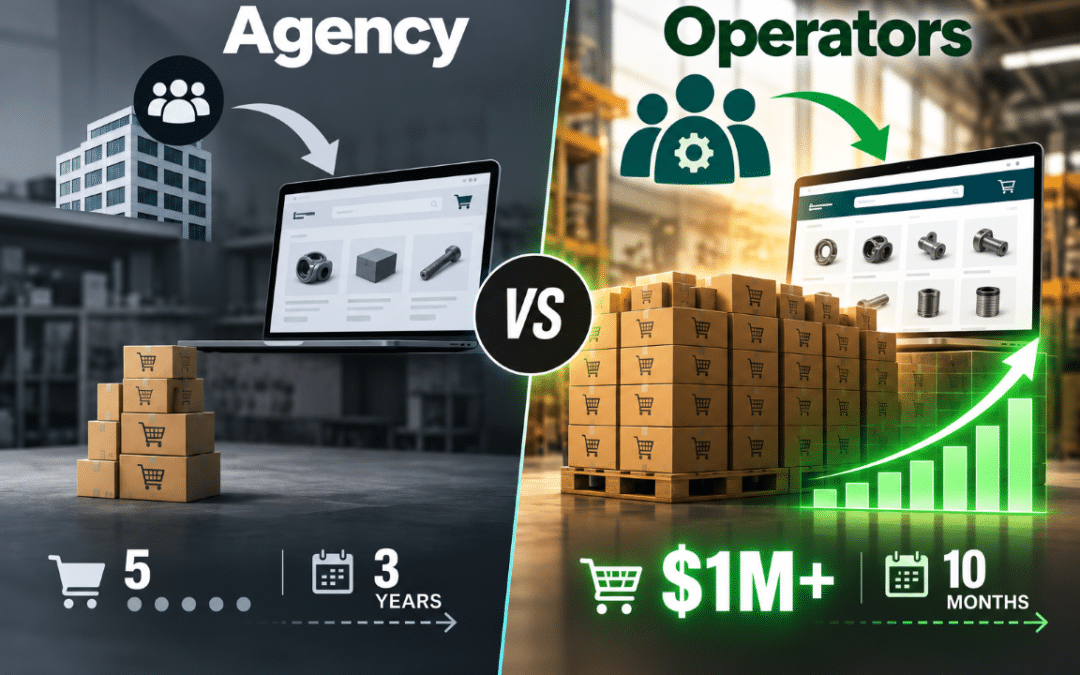
That model converts traffic into recurring digital revenue. One battery distributor generated more than $1 million worth of digital sales in less than 10 months. ECommerce orders had totaled five over the previous three years.
Predictable Pallets Vs. Erratic ‘Eaches’
Most attempts at eCommerce for manufacturers and distributors fail because industrial plants and digital commerce operate with different logistics.
Midmarket industrials and distributors designed systems for bulk ordering: pallets, cartons and predictable replenishment cycles. A distributor will typically order 10 cartons of switches, five cartons of connectors and two cases of control modules.
And the plant engineered its warehouse to efficiently stage and ship that bulk volume.
Digital B2B customers need what the industry calls “eaches” – individual product units. These customers want one replacement switch, two connectors and two modules, in stock, correctly priced. And they want them shipped within 24 hours.
In eCommerce, that is five “eaches” across three SKUs.
That is a completely different operational problem. Legacy warehouses cannot pivot to individual “each-picking” to meet the strict fulfillment SLAs of Amazon, Walmart or big-box retail drop-ship portals.
So orders stall. Pricing stays static. Customer service cannot handle real-time digital inquiries. Together, those failures produce poor user experiences, and the initiative collapses.
Agencies do not know what to do. Because a better-looking online store does not fix a loading dock problem.
Building a B2B eCommerce Platform the Right Way
Industrial leaders should not force their core manufacturing plants or legacy ERPs to behave like parcel distribution centers. That creates technical debt instead of streamlining operations.
The model Tompkins Ventures offers takes the opposite approach to online B2B sales. ECommerce for manufacturers and distributors runs separately from the core operation.
Instead of billing hourly fees to consult, operating partners run a parallel commercial engine. The eCommerce business handles operations, technical integration, catalog management and end-to-end 3PL parcel fulfillment.
Most importantly, the manufacturer or distributor bears none of the capital cost. They invest no CapEx, add no headcount and face no billable hours. Partners earn compensation purely from the net profit they create.
$0 to $1M+ in Under 10 Months
This operator model fixes the execution mismatch that keeps live platforms from generating and fulfilling real orders. The regional battery distributor mentioned above shows how this works in practice. The company had deep inventory, technical expertise, a strong market presence – and three years of failure running its own B2B eCommerce platform.
Their customers sought replacements online. But the company could not sell and deliver single batteries profitably without overwhelming warehouse operations.
A Tompkins Ventures operating partner stepped in and built a parallel commercial engine.
The partner first examined the product catalog, targeting standard batteries – quick to pick, pack and ship through common carriers – for early launch. Flooded lead-acid batteries, classified as hazardous material and requiring shipping by freight, followed on a separate track.
Expensive shipping made some lower-cost batteries impossible to sell profitably online. A $20 battery that costs $15 to ship nets few sales. Optimizing the shipping setup cut those costs by double digits. That made direct-to-consumer sales viable on those products.
The operation expanded across Amazon, eBay, Walmart and other marketplaces at once. The company’s ERP system synchronized inventory, orders, customer data and product data across every channel. A vehicle-specific search tool let shoppers find the right battery by entering a car or motorcycle’s make, model and year. That personalized buying experience mattered, since a single battery can fit dozens of different vehicles.
That is how the distributor generated more than $1 million in digital sales in under 10 months. The business now averages 700 to 800 online orders a month.
Those results came without adding internal headcount or disrupting core wholesale operations. And volume continues to expand to include a distributor-owned white-label brand.
What Catalogs Fit eCommerce for Manufacturers?
This partner-operated model is not designed for every catalog. It fits midmarket manufacturers and distributors that meet four criteria:
- Established brands: Products that commercial buyers already know and search for but cannot easily purchase online.
- Replenishable SKUs: Industrial parts, tools, components or maintenance supplies that generate recurring, predictable order volume.
- Healthy gross margins: Manufacturers whose margins can absorb marketplace fees and fulfillment costs while still turning a real profit.
- Unserved digital demand: Products resold online by third parties because buyers cannot order directly from the source.
Heavy or bulky products are not automatically excluded. Many assume freight and handling costs make those SKUs unprofitable online. But the right pricing and fulfillment approach can change that math.
Digital Demand Needs Operators, Not Software
Midmarket manufacturers and distributors already have customers who want to buy more, in more places, without calling a sales rep. Most of that demand goes unserved, not because the market is small, but because no one built the operation to fulfill it.
Building that operation does not require an expensive agency retainer or another 18 months to create an eCommerce website. It does require a partner with skin in the game.
Connect with Tompkins Ventures to turn eCommerce for manufacturers and distributors into a profitable, parallel digital business.
Related Reading
- RFID Inventory Management Systems Are Your Foundation
- ECommerce Delivery Tracking Requires Parcel TMS
- Inventory Tracking Systems that Pay for Themselves

Tompkins Ventures matches your enterprise’s challenges with our network of 1000s of Commercial Partners, Capital Partners and Consulting Partners. Our toolbox is unlimited, as every Tompkins Ventures Partner has decades of experience helping companies address the five major factors for business success: Leadership, Capital, Technology, Supply Chain/Facilities and Procurement. In today’s business environment of continual disruption, even the best companies do not do everything great. Your core competency is your business. Our core competency is selecting the right Partner(s) to work with your executive teams to make good companies great. Business strategy and supply chain expert Dr. James A. Tompkins founded Tompkins Ventures in 2020. Our network is based in the U.S. but operates on all continents except Antarctica.