
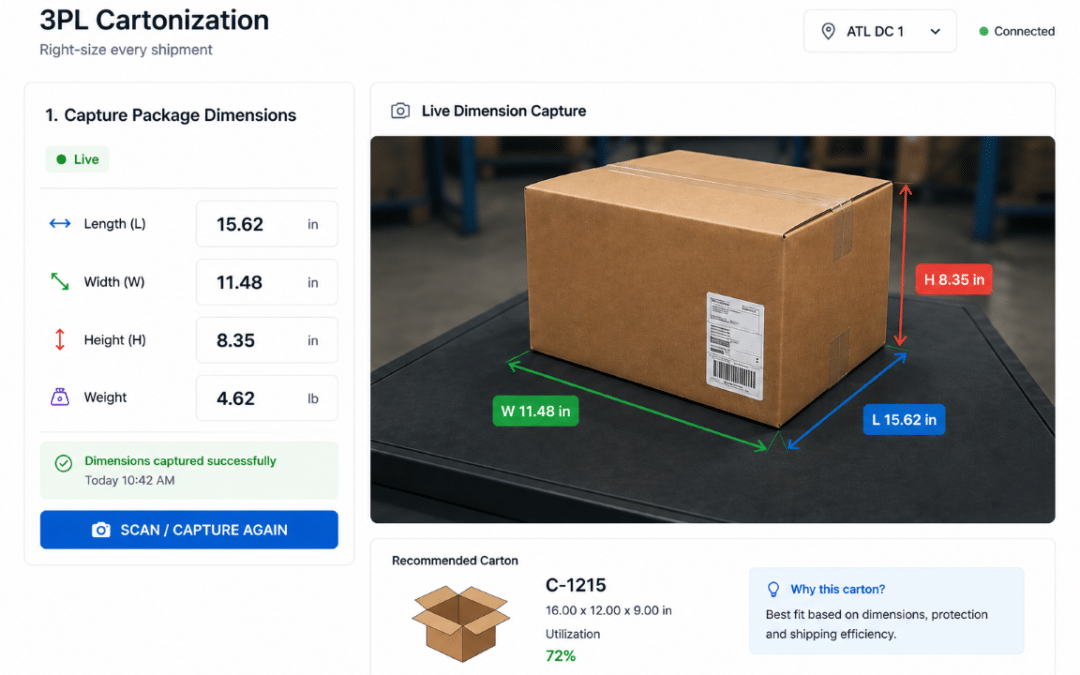
Accurate Item Dimensions Often Separate Renewals from Losses
Midmarket is where profitability lives for most 3PLs. And losing a few clients can cripple operations. The right cartonization software could be the difference between survival and extinction.
Brands rarely walk over price alone. But they will shop around when freight costs balloon and nobody can explain why. They will look for better service when their customers complain about small items shipped in large boxes padded with excess void fill.
The answer usually traces back to the same source – lack of accurate item dimensions.
Some 3PLs and companies use cartonization software to choose the box for every order. Others do not. But few have verified the data the software relies on. Bad data leads 3PLs and companies to pick the wrong box, order after order.
Both companies and 3PLs pay for the oversized box and the wasted freight, and both risk displeasure from customers who notice the waste. 3PLs face the additional problem that dissatisfied brands can take their business elsewhere.
Tompkins Ventures works with 3PLs and companies on exactly this kind of data accuracy. We connect clients with the right partner to cut freight and packaging costs – and, for 3PLs, to keep a renewal conversation from turning into a lost contract.
Where Cartonization Software Fits in the 3PL Stack
Most 3PLs assume cartonization software already does its job well. In practice, the software runs constant calculations. It tests millions of box and carrier combinations for each order and picks whichever pairing delivers the lowest total cost. That is a lot more than choosing a size off a shelf.
The software typically works alongside a 3PL’s existing systems, drawing on item data to return a pack instruction for each order. When that data integration works well, the process looks seamless from the warehouse floor.
But seamless integration only confirms the software is running, not whether the numbers behind each decision are correct.
How Bad Data Breaks the Box-Selection Algorithm
Cartonization software fails for one reason more than any other – the software was never fed accurate item dimensions in the first place.
The disconnect starts inside the warehouse. Brand managers care about how much air ends up in the box, because that number drives freight and packaging material costs. Warehouse teams care about getting the order out within the service level agreement. Neither group ends up responsible for verifying the data, so manual measurements and outdated records can sit unverified in the system indefinitely.
The algorithm cannot tell the difference between a correct measurement and a wrong one. It runs the same calculation either way. A wrong input produces a wrong box every time, no matter how sophisticated the software is.
That is the real failure point. Software rarely fails on its own. Bad data does the damage long before the algorithm runs.
Verified Data Gives 3PLs a Head Start on Renewing Contracts
Verifying the data fixes the immediate problem. Most 3PLs treat that as the end of the project, not the start of something new.
That framing misses an opportunity.
A 3PL that sells accurate item dimensions as part of the client relationship keeps the data on its side of the table. That data becomes the foundation for an ongoing program, not a one-time fix.
A typical program does more than assess dimensions once. Partners visit the site each month, so measurements stay accurate as product lines change. Monthly or quarterly business reviews add a status report and specific recommendations, giving the 3PL ongoing proof of value to show the client instead of a single project summary.
The 3PL that owns this data has something to show at renewal time beyond a lower price. Losing that 3PL means losing the data behind it, and shipping costs climb again the moment the account moves. The cost savings compound each year the 3PL keeps the account.
That is a cost-effective, long-term argument for shippers to stay with the 3PL that owns their data. The logic holds because a renewal conversation that starts on price gives a brand every reason to compare quotes. One that starts with results changes the terms of that comparison.
Account teams with verified data do not need a sales pitch for the meeting. They bring a stack of business reviews instead. Each report ties one change in the operation to one measurable result.
That history is difficult for a brand to dismiss, and even harder for a competing 3PL to match on day one.
Instead of defending a price against a competitor’s quote, the account team can point to a documented trend of lower shipping costs and fewer complaints about oversized, wasteful packaging.
The Business Case for Better Cartonization Software
Verifying dimensional data costs money, but losing an account costs more. 3PLs that already run cartonization software need to make sure the investment pays dividends.
ROI on accurate item dimensions typically runs 400% to 600%. That return is difficult for any finance team to ignore. The benefits extend past the invoice as well. Freed storage space, smoother warehouse operations and a faster packing process follow when boxes match what is inside them.
None of that changes the calculation 3PLs already face at renewal time. Contracts do not usually fail over price. They fail when a brand cannot explain why its packaging still looks careless after months as a client. Verified data answers that question before the renewal conversation starts.
3PLs ready to make that case can start the conversation with Tompkins Ventures about which cartonization software partner fits their operation.
Related Reading
- Only the Right Packaging Solution Really Delivers
- Warehouse Design Should Start with Flow, Not Space
- Ship Less Air, Save 10-25% on Freight

Tompkins Ventures matches your enterprise’s challenges with our network of 1000s of Commercial Partners, Capital Partners and Consulting Partners. Our toolbox is unlimited, as every Tompkins Ventures Partner has decades of experience helping companies address the five major factors for business success: Leadership, Capital, Technology, Supply Chain/Facilities and Procurement. In today’s business environment of continual disruption, even the best companies do not do everything great. Your core competency is your business. Our core competency is selecting the right Partner(s) to work with your executive teams to make good companies great. Business strategy and supply chain expert Dr. James A. Tompkins founded Tompkins Ventures in 2020. Our network is based in the U.S. but operates on all continents except Antarctica.