Errors Can Slip Through After the Invoice Is Paid
Most finance teams assume the freight and parcel shipping billing problems end once pre-audit clears invoices and payments go out. Post-auditing exists because that assumption holds up less often than most shippers expect.
Unfortunately, 5 to 10 percent of freight and parcel invoices carry some kind of error. Shippers inadvertently misapply accessorial charges and fuel surcharges. Or human coding errors create duplicate payments. Pre-audit, however well it runs, only catches what’s visible when the bill gets checked.
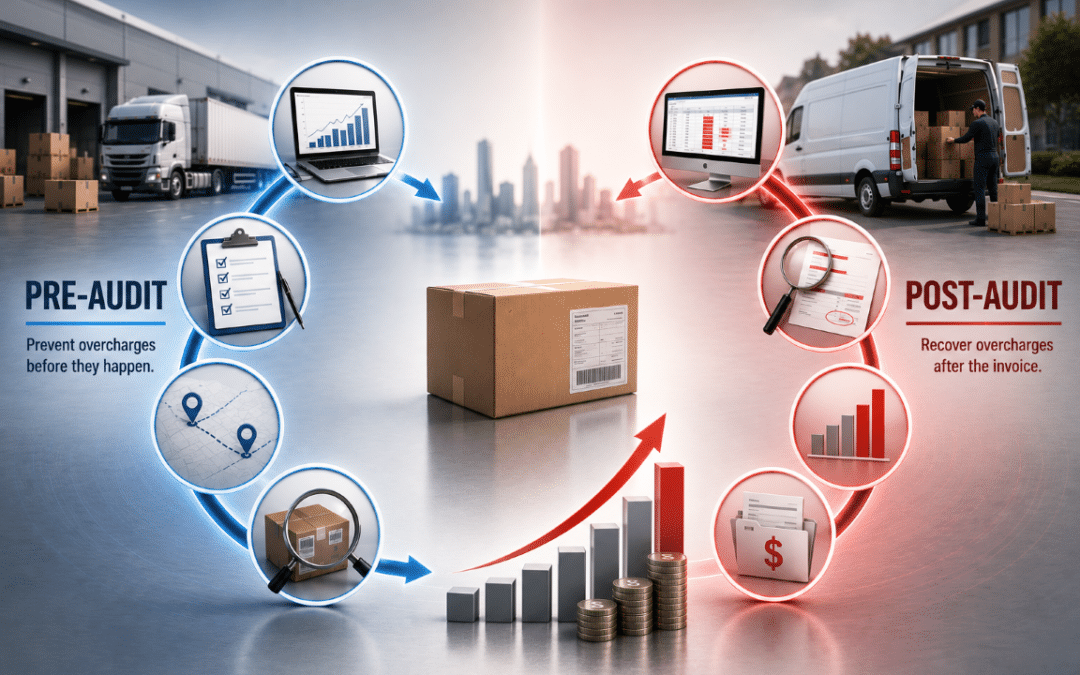
That distinction matters because pre-audit and post-auditing aren’t the same safeguard pointed at different invoices. They’re two different windows into the same spend, and each window shows something the other one can’t.
Where does pre-audit coverage end for your company? And what post-auditing savings are left on the table? A post-auditing service can trim 3%-10% from your freight and parcel billing.
Tompkins Ventures can help you find that missing money. The service is contingency-based and risk-free. Your parcel shipping and freight budget has everything to gain and nothing to lose.
Why Post-Auditing Catches What Pre-Audit Cannot
Pre-audit works by checking an invoice against the contracted rate file at the moment that invoice gets submitted. It can only confirm what it can see, and only at one point in time. That boundary isn’t a flaw in the system. It’s the edge of what pre-audit was built to do.
Post-auditing works differently because it reconciles the full paid history instead of a single transaction. It can compare invoices against each other and against a carrier’s later corrections. Post-auditing can even compare invoices against the original shipment record weeks or months after the original payment cleared.
That reach lets post-auditing recover money pre-audit never had the chance to see.
Parcel Post-Auditing Catches What Weight and Service Data Hide
Parcel billing has actually gotten more complex than freight billing in most operations. Invoice formats for parcel shippers have grown from hundreds to thousands. That line item volume alone is ripe for errors.
Many businesses that pride themselves on keeping a close eye on freight billing skip parcel entirely. The 21st century explosion of eCommerce makes that a costly mistake.
A parcel audit looks for a different kind of error than freight, one that comes from weight and service data instead of contract terms.
Parcel carriers routinely re-measure package dimensions after shipments are already moving through their network. They can rebill the difference once that scan comes back, sometimes weeks after the original invoice cleared.
A pre-audit system cannot anticipate a measurement that hasn’t happened. So the rebilled amount goes unchecked unless someone reconciles it later against the original shipment record. Left unchecked, that rebilling habit can quietly inflate shipping costs across an entire parcel program.
Likewise, service failures create the same kind of opening.
Late deliveries and missed service commitments often qualify for a refund under a carrier’s own service guarantee. But carriers don’t automatically give those refunds.
Instead, shippers must contact the carrier’s customer service department directly and file within a narrow window. Most shipping teams lack the staff to track every delivery against its promised window across thousands of packages a month.
One parcel shipper with $14 million in annual spend recovered $161,291 in eight months. That happened after a detailed billing review went back through five months of invoices.
None of that money showed up when the bills first went out. It surfaced only because someone looked again, after the fact, with the full record in hand.
Freight Post-Auditing Finds Money Invoices Never Show
The clearest benefit from freight post-auditing comes from duplicate bills that don’t look like duplicates.
Sometimes a carrier mistakenly resubmits a bill under a different invoice number. Or the carrier bills once and the broker handling that same load bills again. Either way, the duplicate charges are real, even though the shipping invoices don’t look suspicious on initial review.
Partial and split invoices create a similar problem. A single shipment billed across two or three separate invoices can pass pre-audit on every line. After all, each line matches the rate table.
The error only surfaces when someone reconciles those invoices against the full shipment total. Pre-audit was never built to make that comparison. Post-auditing, by design, identifies overcharges like this.
Then there’s the rebill that hasn’t been generated yet. Carriers sometimes automatically issue a second invoice if the first one goes 30 days past due. This can happen even after the original bill already cleared pre-audit and payment went out.
Pre-audit can’t flag a bill that doesn’t exist. Post-auditing can, because it looks at the paid history well after that 30-day window closes.
How Tompkins Ventures Supports Post-Audit Recovery
A solid pre-audit and payment provider or system can save shippers money. But neither one eliminates the categories above, because both are built to check invoices as they arrive. They simply don’t have the ability to look back across months of paid history.
Tompkins Ventures connects shippers with audit services that handle that backward look across both freight and parcel spend. At no cost and no risk, companies typically recover 3 to 10 percent of total spend. Real-time reporting tracks recoveries as they happen, and shippers only pay once money actually comes back.
Catching what’s already been paid doesn’t undo the original error. But it gets the money back to the bottom line. And it gives shippers a clearer, long-term picture of where to tighten pre-audit going forward.
Shippers who assume their billing process ends at payment are usually the ones leaving the most money behind.