
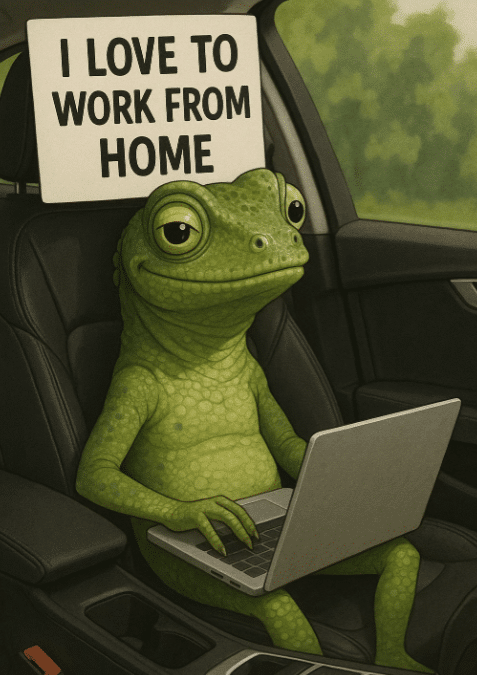
Weak Leadership Systems Need Better Design – Not Forced Proximity
Years after the pandemic, boardrooms remain in a panic about how to deal with work from home, hybrid work or in-office models.
I turn to The Wall Street Journal and find articles on a small cohort who hate remote work and advice on how to make return-to-office mandates and hybrid work models succeed.
They make some good points. One entrepreneur likened being glued to a computer screen all day to “being a captive animal in the zoo. You know, like a captive human.”
(My response, of course, is that if he’s an entrepreneur, he can tell himself to go to the office – which he did later in the story.)
The advice article has great pointers for improving how organizations develop people in an office setting: Focus on solid onboarding, redefine job responsibilities and make it useful to be in the office. That’s Organizational Development – just in a physical setting.
But as I’ve said before, I think they’re fighting against the future of work.
The latest research from the Survey of Working Arrangements and Attitudes (SWAA) showed remote work accounted for nearly one-fourth of all paid workdays in the United States. The story about miserable remote workers noted that only 3% of those away from the office want to return.
To top it off, Gen Z has declared that when they are in charge, everyone will work remotely. At least according to Inc. magazine. Gen Z plans to support remote work policies once the baby boomer and Generation X step aside.
But they’re going to need to do more than support policies. Because frankly, when work from home arrangements struggle, the problem usually isn’t the worker.
It’s the system. It’s your Organizational Development.
Stop Blaming Remote Work for Your Problems
Yes, some jobs require colocation. You can’t run a distribution center, operate heavy machinery or perform surgery from your kitchen table. Physical work requires physical presence.
But a large portion of knowledge work does not.
And when leaders insist that everyone must return to the office, I often see something else at play. Instead of redesigning work, they blame remote work itself. Instead of clarifying expectations, they demand proximity.
Organizations designed in a remote-first world continue to perform well while operating remotely. Older firms built around supervision are the ones struggling.
Like many facets of life – business and personal – this shift in the future of work simply demands better system design.
Industrial Engineering 101 – Define the System
From an industrial engineering perspective, this is straightforward.
You start by defining:
- Clear objectives
- Measurable key results
- Shared values
- Strategic alignment
If you put those in place, people don’t need constant supervision. They know what they are accountable for, what success looks like. They know how their work connects to the larger strategy.
Without those four, managers compensate by hovering over their workers.
That takes me back to warehouse floors and factory shifts. Many operations have 10-minute pre-shift huddles. The first five times you attend, they’re valuable. Safety reminders matter. Performance metrics matter. Culture messaging matters.
But the next 559 times?
Unless the supervisor is engaging and creative, it becomes noise. Eyes glaze over, and valuable information gets dismissed as malarkey.
Presence ≠ productivity. And presence certainly doesn’t equal engagement.
Work from home exposes this truth. When you can’t rely on physical oversight, you’re forced to design for outcomes. And that future of work is uncomfortable for leaders who have built careers around supervision rather than system design.
If your people know the objectives and key results, what exactly requires them to sit 20 feet away from you?
The Data Shows Work from Home Is a Structural Issue
The latest data reinforces this.
As noted earlier, 24.5% of paid workdays are still being done from home
Even more telling, younger firms founded since 2015 have about 50% higher work-from-home rates than firms founded before 1990, according to SWAA.
Why? Because leaders designed their processes differently, with more flexible structures. And their leaders manage to outcomes, not hours in a seat.
Again, it’s not the worker. It’s the system design.
Consider self-employed professionals. Survey data shows they have almost three times more work-from-home days per week than wage and salary employees, and over 40% are fully remote.
Why? Because self-employed people operate with crystal-clear objectives, direct revenue accountability and no need for hovering supervision.
The more accountable someone is to outcomes, the less supervision they require. That’s not a coincidence.
And there’s another important insight in the data. The gap between how much people want to work from home and how much they actually get to do so largely stems from the number of fully in-person jobs offered.
That’s not Organizational Development. That’s leadership insecurity. Too many companies still structure jobs around control rather than outcomes.
The firms designed for clarity thrive in the future of work. The firms designed for supervision struggle.
The Real Fear – Being Called a Bad Boss
There’s another dynamic at work.
Some leaders want people back in the office because of optics, not performance.
They don’t want their own bosses questioning their oversight. They believe, consciously or not, “If I can see you, I must be managing you.”
But proximity is not leadership. Leadership is clarity, alignment and accountability.
You can be an exceptional manager across time zones. At Tompkins Ventures, we operate across the globe. Even if we all sat in the same building, much of our communication would still happen through structured meetings, digital platforms and documented objectives.
The basketball conversation at the coffee pot doesn’t determine performance. The objectives and key results do.
The System Always Wins
Work from home is a stress test for leadership quality and Organizational Development.
It forces leaders to answer uncomfortable questions:
- Have we clearly defined what success looks like?
- Are our key results measurable and understood?
- Do our people share our values and strategy?
- Are we managing to outcomes or to activity?
Companies that pass this test build durable systems. Companies that fail it demand proximity. I know which type of company will win in the future of work.
If your management system requires constant proximity, the flaw isn’t location. It’s system design.
Related Reading
- Like Entrepreneurs, Let’s Think Like Chief Value Officers
- Corporate Return‑to‑Office Plans Seem More Bark Than Bite
- Want to Hire from the Class of 2023? Re-engineer Work.

Jim Tompkins, Chairman and founder of Tompkins Ventures and Tompkins Solutions, is an international authority on designing and implementing end-to-end supply chains. Over five decades, he has designed countless industrial facilities and supply chain solutions, enhancing the growth of numerous companies. Jim earned his B.S., M.S. and Ph.D. in Industrial Engineering from Purdue University.