
Engineered Alternatives Cut Cost, Damage and Waste
Companies spend heavily to protect shipments of high-value equipment. Many design wooden custom shipping crates for their products. Because each crate usually makes only one trip, that spending can reach hundreds of thousands or even millions of dollars a year.
The problem grows with the product line. Each new server configuration, medical system or piece of industrial equipment requires its own crate design. Every design adds engineering time, lead time and waste. That extra cost can eat into the margins new products are supposed to deliver.
Tompkins Ventures helps companies replace one-way crating with reusable, engineered platforms. Our partners’ wooden crate alternatives protect valuable items, return easily for reuse and lower the cost of every shipment.
Wood Custom Shipping Crates Carry Hidden Costs
Wood has protected cargo for thousands of years, and many crating services still use it. A skilled builder can fit a crate to a product with real attention to detail.
But that crate usually makes one trip. A wood crate cannot fold flat, so empty returned boxes take up just as much space as full ones. That gets expensive fast, which is why most companies discard crates at the destination.
International shipping standards add another layer of cost. Wood packaging that crosses borders must meet phytosanitary rules. Those rules require heat treatment or fumigation, along with an official mark. The United States enforces the same standard on imports, and inspectors can turn away shipments with noncompliant wood. So compliance adds treatment steps and cost to every wood crate.
Then there is the risk of damage. Wood splinters on impact, does not absorb vibration well and cracks when struck by a forklift blade. Even with protective filler inside, a dropped wood crate can damage fragile items such as server racks, computer equipment and medical systems.
On the other hand, our partners have engineered crates that protect cargo from drops and forklift strikes. To date, no customer has ever reported a damaged shipment using these crates.
How Our Partners Engineer Custom Shipping Crates
Companies that ship high-value systems on a regular cycle need better options. The best wooden crate alternatives protect delicate equipment and can be used again and again. They adapt to more than one product so companies do not have to engineer a new crate with every new model. And they show managers where each high-value shipment sits at any moment.
Tompkins Ventures connects companies with partners whose reusable crate platforms meet those needs. The work starts with a core configuration. Engineers then add fixtures that hold cargo in place along the X, Y and Z axes. When a product needs more, they build a fully custom design for that use case.
That approach gives companies custom shipping crates tailored to each product. The same platform can carry server cabinets, electronics, medical equipment, robotics and automation systems. The fixtures keep a medical robot or automation system from shifting inside the crate, so it reaches its destination intact.
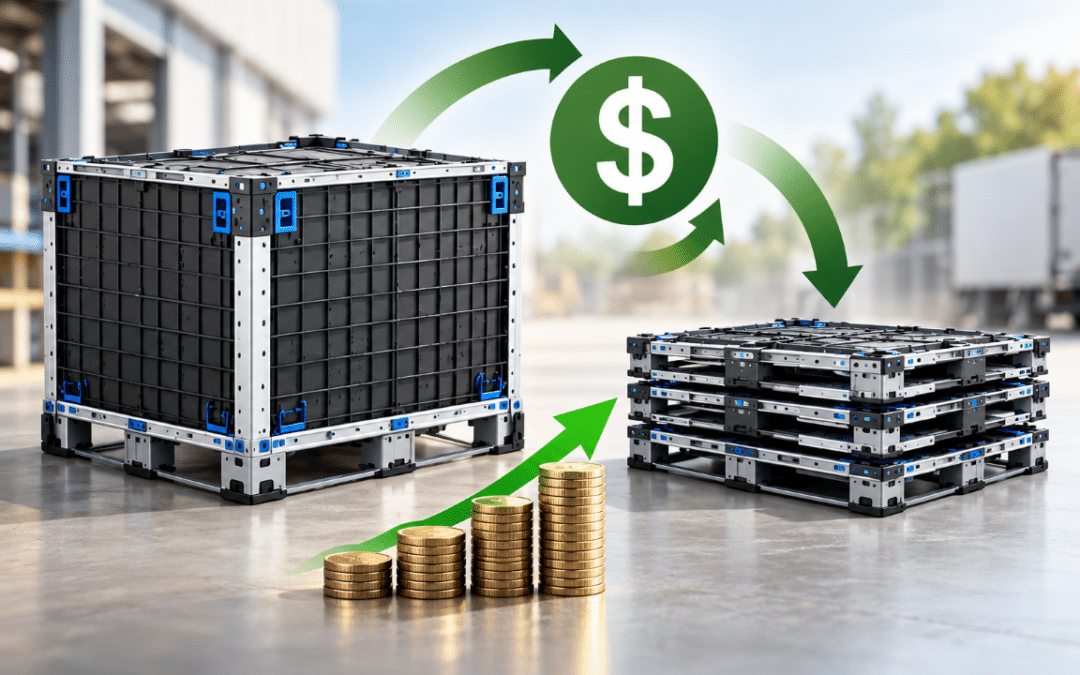
Teams assemble the crates without tools in less than four minutes. After delivery, the crates collapse to 30% of their assembled size for storage and return.
One customer with 40 years of freight experience compared setup to “putting up a kids playset outside.” That speed matters on a busy dock, where packing time drives labor cost.
Saving 40% on Monthly Server Rack Shipping
One case shows how this works in practice.
A leading server rack integrator builds high-value AI systems in the United States, Taiwan and India. It ships server racks on a monthly cycle. The company wanted to reduce wood crate costs and damage caused during transit. It also needed tighter security and better sustainability reporting.
The integrator connected with our partner. Now, after racks ship out by air, the flat, empty crates come back by truck and ocean freight on a two- to five-week turnaround. Each crate carries tracking that reports location and environmental conditions in real time. Protective covers add security and shield the systems during international shipping.
Since the switch, the integrator reports zero product damage and zero security incidents. Packaging costs fell 40% compared with traditional wood crates, and return shipments take 70% less space. Teams load and unload racks faster and more safely. The reusable system also cut waste, which helped the company meet internal sustainability targets and strengthen ESG reporting.
Custom Shipping Crates Pay Back With Each Trip
A wood crate’s cost repeats with every shipment, because each crate makes one trip. Reusable crates spread their cost across many trips, so cost per shipment falls over time.
While the integrator’s server rack shipping program saved 40% on packaging, some customers have saved twice that. Those cost savings grow as shipping volume rises. A company saving 40% on 100 shipments a year saves twice as many dollars on 200 shipments a year.
Avoiding damage adds to the ROI. When equipment arrives safely, the company avoids repairs, replacement units, expedited freight and damaged customer relationships. Real-time tracking adds peace of mind because managers can see where each shipment is.
Any company that ships fragile items can benefit from engineered reusable custom shipping crates. Industrial equipment, medical systems and even fine art all need high-quality protection. By the 10th trip, long after a wood crate would have gone to the landfill, the reusable crate is still in service, shipping and protecting cargo.
Tompkins Ventures helps companies see what crating really costs across their product lines. We then match your needs with the right partners. The result is fewer one-way crates, fewer damaged units and a lower cost for every custom shipping program.
Related Reading
- Can a Shipping Crate Eliminate Damage? Yes.
- AI in Warehousing Won’t Fix Broken Processes
- Workforce Development for Reshoring American Manufacturing

Tompkins Ventures matches your enterprise’s challenges with our network of 1000s of Commercial Partners, Capital Partners and Consulting Partners. Our toolbox is unlimited, as every Tompkins Ventures Partner has decades of experience helping companies address the five major factors for business success: Leadership, Capital, Technology, Supply Chain/Facilities and Procurement. In today’s business environment of continual disruption, even the best companies do not do everything great. Your core competency is your business. Our core competency is selecting the right Partner(s) to work with your executive teams to make good companies great. Business strategy and supply chain expert Dr. James A. Tompkins founded Tompkins Ventures in 2020. Our network is based in the U.S. but operates on all continents except Antarctica.