
Kimi K3 Cuts Enterprise AI Costs by Two-Thirds
You’re prepped for surgery, mask coming down, when you ask the doctor how much longer. “We’re done,” he says – two hours gone in what felt like a blink. A new Chinese AI model just did the same thing to an entire industry.
We used to clock AI progress in years. Then quarters. Now the categories of what’s possible shift while you’re still reading last week’s headlines.
Last week, we blinked.
And when we woke up, we found out that China’s Kimi K3 runs at less than a third the price of Claude Fable 5. Enterprise AI costs are about to fall, fast.
AI Is Moving Faster Than You Can Track It
That surgery-table jolt wasn’t hyperbole. Major AI model releases climbed from 18 in 2023 to 69 in 2025, according to Business Insider. By mid-2026, companies had already released 30 more. AI upgrades that used to ship every few months now ship every few weeks.
Try running a normal evaluation process on that timeline. Assemble a committee, write the RFP, test the finalists. By the time you’re ready to decide, the model you were examining is already two versions behind.
China’s Kimi K3 landed right into that acceleration. The Chinese AI model didn’t need a breakthrough to feel like a shock, only a week when the industry had stopped bracing for something that size.
We’ve felt this particular kind of vertigo before. Nearly seven decades earlier, another country’s surprise reset an entire nation’s assumptions about who was ahead.
Are We Back to 1957? It’s Sputnik All Over Again
On Oct. 4, 1957, the Soviet Union launched Sputnik, a satellite roughly the size of a beach ball. The satellite did almost nothing useful, just beeping while it circled the Earth every 90 minutes.
But the beeping came from the wrong side of the Cold War. Americans had assumed their country held a clear lead in science and engineering. Sputnik said otherwise, and the shock was immediate.
Congress created NASA within a year. Schools rewrote science and math curricula under the National Defense Education Act. One small satellite that accomplished almost nothing in orbit rearranged a decade of national spending, priorities and pride.
Nobody remembers Sputnik for what it did in space. They remember it for what it did on the ground – proof that a lead nobody had questioned in years wasn’t as secure as everyone assumed.
A Chinese AI model just delivered that same lesson. No rocket required.
The Chinese AI Model Behind the Shock
Kimi K3 comes from Moonshot AI, a Chinese lab racing to match the handful of “frontier labs.” Those are the companies, like Anthropic and OpenAI, that build the world’s most advanced AI systems. Moonshot released Kimi K3 on July 16.
Full weights, the values that make the model actually run, arrive July 27 under a Modified MIT license, the same permissive terms Moonshot used for its earlier Kimi models. Once those weights are public, anyone on Earth can download Kimi K3 and run it without ever sending Moonshot a query.
At 2.8 trillion parameters, it’s the largest open-weight model ever released. Parameters aren’t a perfect stand-in for intelligence, but no open model has come close to this scale before.
The benchmarks back up the size. Independent testing firm Vals AI ranks Kimi K3 second overall among 38 models, ahead of Claude Opus 4.8 and GPT-5.6, trailing only Claude Fable 5. Kimi K3 even beat Fable 5 outright on a closely watched front-end coding benchmark, the test of building what users see and click.
None of that came from a secret breakthrough. It came from something far more useful for the rest of us to understand.
Chinese Companies Have Won This Game Before
Kimi K3 doesn’t run on some secret new kind of AI. It’s the same basic method every major lab already uses – tuned for speed and efficiency, not replaced with something new. No next-generation architecture. Just disciplined engineering, built on a known foundation.
That should sound familiar. Chinese EV makers got relentlessly good at building cars for far less than comparable U.S.-made EVs.
Nobody credits them with reinventing the automobile. They get credit for manufacturing discipline, and that discipline is beating companies that had a decade’s head start. That story is similar to how China became the manufacturing hub of the world over the last few decades.
Kimi K3 is the same story, only in artificial intelligence instead of steel.
That raises an uncomfortable question for companies spending fortunes chasing the next big architectural leap. What if the breakthrough they’re hunting isn’t the one that matters? Moonshot didn’t invent a new AI. Its engineers just out-executed Silicon Valley.
Cheap Intelligence Is a Gift – Unless You’re Selling It
Execution like that has a direct, measurable consequence: price. The average price of a million AI tokens – about 750,000 words of output – fell from $10 to $2.50 in a year. That’s according to enterprise spending data cited by research firm Artefact. Kimi K3 pushes that slide further and faster.
When something scarce and expensive turns cheap and abundant almost overnight, nearly everyone wins. The exception is whoever built a business on charging a premium for the scarcity. That’s exactly the position the foundation AI labs find themselves in now.
For every other business, the math runs the other way. The tools writing code, answering customer emails and cleaning up spreadsheets got sharply cheaper and more capable in the same week. That shows up as a line item shrinking on next quarter’s budget, not an abstract shift somewhere in the industry.
Optionality Beats AI Vendor Lock-In
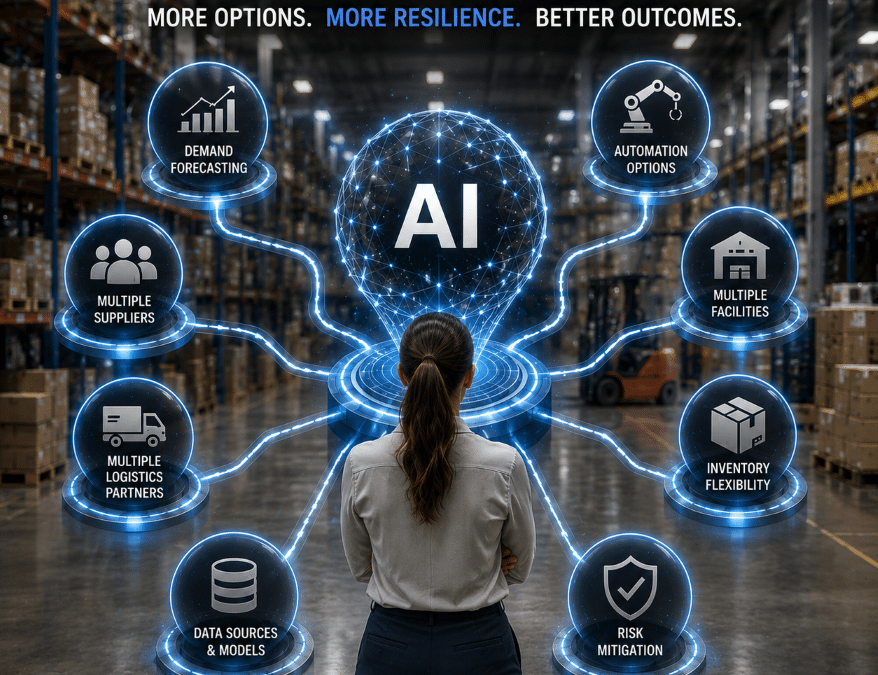
I’ve spent years telling manufacturers not to build their supply chain around a single supplier. The same rule applies to AI, and this week proved it.
A company that can download a model like Kimi K3 and run it on its own servers has a choice. It isn’t betting everything on one vendor’s roadmap, pricing or uptime. That’s optionality: the ability to swap, not the obligation to guess right the first time.
Go back to that RFP committee from earlier. Standardizing on one AI vendor asks you to correctly predict which company wins a race that resets every few weeks. Building optionality into your AI strategy asks something easier: keep more than one door open. Let the tools compete for your business instead of locking you into theirs.
One door worth keeping open: a model that isn’t Chinese. Washington is reportedly weighing restrictions on U.S. companies’ use of Chinese AI models, Kimi K3 included, over cybersecurity concerns. Nothing is decided, and banning software anyone can already download is hard to enforce. But building your entire AI stack on a model that could get legally complicated next quarter trades one kind of lock-in for another. Nvidia’s Nemotron models are the domestic alternative worth watching – not as capable yet, but real, open and free of that particular risk.
The next surprise is already on its way. Nobody knows which lab ships it, or what it costs. Companies that built in the flexibility to swap won’t need to know in advance. Companies that didn’t will be relearning this week’s lesson all over again.
Related Reading
- AI Supply Chain Execution That Never Stops Improving
- Bad Bosses Can Screw Up Anything – Even Remote Work
- Poor Digital Enablement Hurts the Customer Experience

Jim Tompkins, Chairman and founder of Tompkins Ventures and Tompkins Solutions, is an international authority on designing and implementing end-to-end supply chains. Over five decades, he has designed countless industrial facilities and supply chain solutions, enhancing the growth of numerous companies. Jim earned his B.S., M.S. and Ph.D. in Industrial Engineering from Purdue University.