
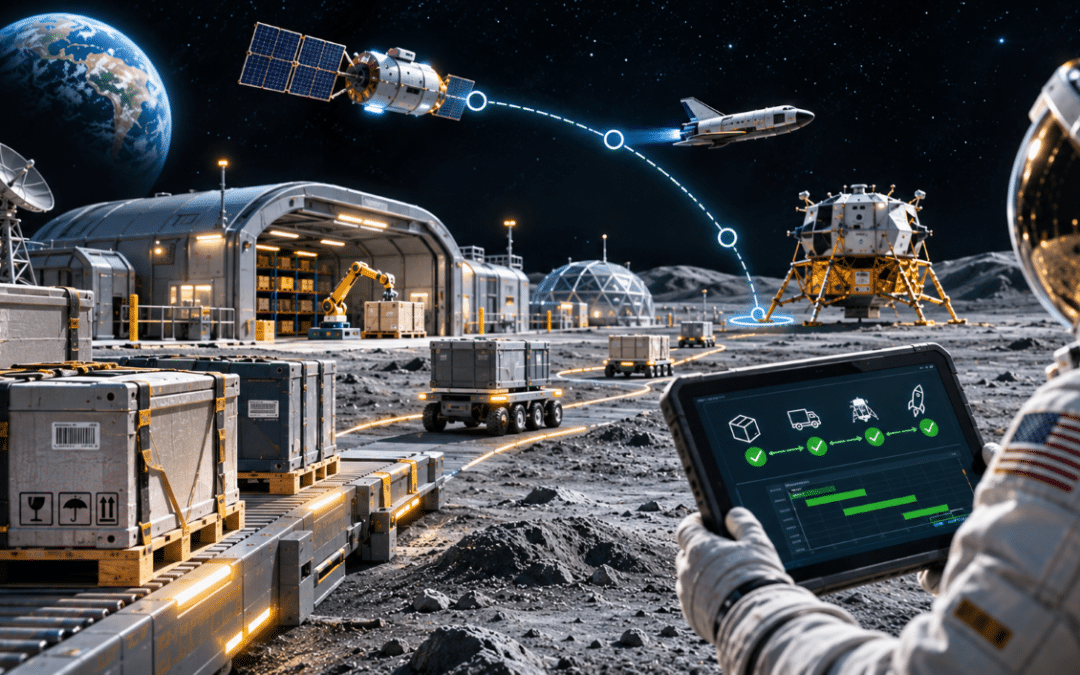
What Satellites, Moon Landers and Fuel Depots Need
Rocket pioneer Wernher von Braun understood space logistics before most people knew the term. While building the Saturn rockets that sent men to the moon, he warned that logistics could eat up to one-third of a program’s budget. In 1966, he presented a paper titled “The Growing Need for Logistics Engineers.”
Sixty years later, we’re here. I’d argue that many of the engineers he had in mind work on Earth right now. They run distribution networks and manage fleets. Most just haven’t looked up.
The American Institute of Aeronautics and Astronautics defines space logistics as managing the flow of materiel, services and information across a space system’s lifecycle. That mirrors what I’ve been doing in supply chain for five decades – getting the right stuff to the right place at the right time.
Only now the stuff is moving at thousands of miles per hour – and needs a boost to get off Earth in the first place.
And space leaves no room for error. On Earth, a damaged shipment gets replaced quickly. In orbit or on the moon, second chances take a long time – if you get a second chance at all.
Less-Expensive Launches Turned Space Logistics Into a Business
For most of the space age, getting off the ground cost too much for anybody but governments and big companies.
According to NASA, it cost about $54,500 for the Space Shuttle to launch a kilogram into low Earth orbit. SpaceX’s Falcon 9 cut that to roughly $2,700. The Falcon Heavy brings it down to about $1,400.
That’s a drop of more than 97%. I would love to run a supply chain project that decreased costs that much!
Low-cost launches attract more frequent fliers. According to Air & Space Forces Magazine (yes, there is such a publication), the Air Force projected in 2017 that Florida’s Space Coast would launch 100 rockets a year by 2030. It got there five years early. Officials now project up to 500 launches a year by 2036.
The invention of the shipping container triggered a similar shift in ocean freight. That story was told beautifully by my friend John McCown in Giants of the Sea. When moving freight becomes cheap and routine, the hard questions change. Where do you stage inventory? How do you service equipment in the field? Who handles the last mile?
Space has reached that point. Yes, getting a satellite into and beyond orbit is cheaper. But the people whizzing around above us cannot drive to the convenience store or order online if they’ve forgotten anything.
The Space Force Already Thinks in Space Logistics
The military figured this out early. Armies have been transporting troops, weapons, food and supplies for millennia. U.S. logistics helped power the Allies to victory in World War II.
The U.S. Space Force published its first doctrine in 2020. The document named space mobility and logistics one of five core competencies. The definition sounds familiar to those of us who have run supply chains: moving and supporting equipment and personnel into space, through space and back to Earth.
In January 2026, Gen. Stephen Whiting, who commands U.S. Space Command, urged the Pentagon to move beyond focusing on launches to include maneuverability in space. The Space Force’s current plans call for demonstrating on-orbit refueling and fielding operational “space tugs” by 2030.
Now the U.S. Space Force’s Space Systems Command wants industry to help with orbital fuel depots and resupply. Currently, a satellite’s working life depends on how much fuel it carries at launch. That’s kind of like buying a new tractor-trailer every time the tank runs dry.
Gas Stations, Tow Trucks and Tractor-Trailers in Orbit
Strip away the jargon and space supply chains look a lot like their earthbound counterparts.
Gas stations. In April 2025, Astroscale U.S. won a contract to perform the first refueling of a Space Force satellite in geostationary orbit. The mission was set to launch in 2026. The Space Force now targets early 2027.
Tow trucks. In September 2025, NASA awarded Katalyst Space Technologies $30 million to increase the orbital altitude of its Swift Observatory. Katalyst’s robotic spacecraft reached orbit in July 2026, but a control problem kept it from connecting to Swift. The mission ended without raising Swift’s orbit, and the satellite re-entered Earth’s atmosphere and burned up earlier this month. You can tow a broken-down truck to the shop most anytime. Swift got one rescue attempt.
Tractor-trailers. Impulse Space is building a vehicle called Helios. Founder Tom Mueller designed the engine that powers the Falcon 9. Helios should be able to carry up to 4,000 kilograms from low Earth orbit to geostationary orbit in less than a day. Consider that a fast tractor-trailer for space.
So far, that’s a record of breakdown and delay. Fleet managers are used to such disappointments. But to turn satellites into assets that companies can maintain, reposition and keep in service, space logistics services are going to need more successes than failures.
Lunar Landings Pose Last-Mile Delivery Difficulties
NASA sends shipments to the moon and into lunar orbit by buying capacity from private companies. NASA is the shipper. The commercial companies are carriers.
Shippers on Earth would not have been happy with the results.
Firefly Aerospace’s Blue Ghost landed on the moon on March 2, 2025, the company’s first delivery through NASA’s Commercial Lunar Payload Services program. Ten science and technology instruments operated for one lunar day, about 14 Earth days.
That was the only complete success out of four flights in the program so far.
Astrobotic’s Peregrine suffered a propulsion failure and didn’t even reach lunar orbit, much less the surface. The spacecraft returned to Earth’s atmosphere, where it burned up in January 2024.
Two Intuitive Machines’ landers reached the moon. But both tipped over, Odysseus in February 2024, Athena a little more than a year later. In addition, Athena landed in a crater, and sunlight couldn’t reach its solar cells. Without the ability to recharge its batteries, the Athena mission ended in less than a day.
NASA and company officials praised all three missions, saying Peregrine sent back data from space and the Intuitive Machines’ landers sent back data from the moon.
But in terrestrial terms, that’s a hit, a miss and two partial deliveries. Not exactly on time and in full. And there’s no reshipping. A tipped-over moon lander just lies there.
Just like on Earth, equipment failures and missed deliveries ripple through programs. NASA is still moving ahead with its plans for a moon base. But the agency has delayed three Commercial Lunar Payload Services launches planned for this year. And the 10 it hoped to launch in 2027 must wait until 2028.
The Space Supply Chain Needs Supply Chain Thinking
Beyond delays, breakdowns and missed delivery dates, the space supply chain still struggles with basic planning numbers.
Take SpaceX’s Starship lunar lander. Before heading to the moon, it must refuel in Earth orbit from a depot filled by tankers.
How many?
In 2021, Elon Musk said four to eight tanker launches. The Government Accountability Office said 16 launches overall. In 2023, a NASA official said the number was “in the high teens.” And in October 2026, a member of NASA’s own safety advisory panel said it could take as many as 22.
If your team said a project needed between four and 22 deliveries, you’d send them back to work. In space, that range is the current state of the art.
Even the size of the market is up for grabs. Research firms put the 2025 space logistics market anywhere from under $1 billion to more than $8 billion.
That’s what a young field looks like. Network design, inventory positioning, reliability engineering and demand forecasting under uncertainty all apply. The space supply chain needs people who already know how to do that work.
Von Braun saw this coming 60 years ago. The logistics engineers he called for are out there. They run warehouses, fleets and distribution networks.
Now they need to look up.
Related Reading

Jim Tompkins, Chairman and founder of Tompkins Ventures and Tompkins Logistics, is an international authority on designing and implementing end-to-end supply chains. Over five decades, he has designed countless industrial facilities and supply chain solutions, enhancing the growth of numerous companies. Jim earned his B.S., M.S. and Ph.D. in Industrial Engineering from Purdue University.