
Failing to Correlate Improvements With Lower Cost Can Get Expensive
Safety leaders hear the same question at every budget review. What does the program return? Few can show safety ROI in finance terms – claims, workers’ compensation premiums and renewal costs.
That kind of language will get finance to open its purse strings. Programs that cannot show such returns are hard to defend when budgets tighten, even if those programs prevent the injuries that drive workers’ compensation costs.
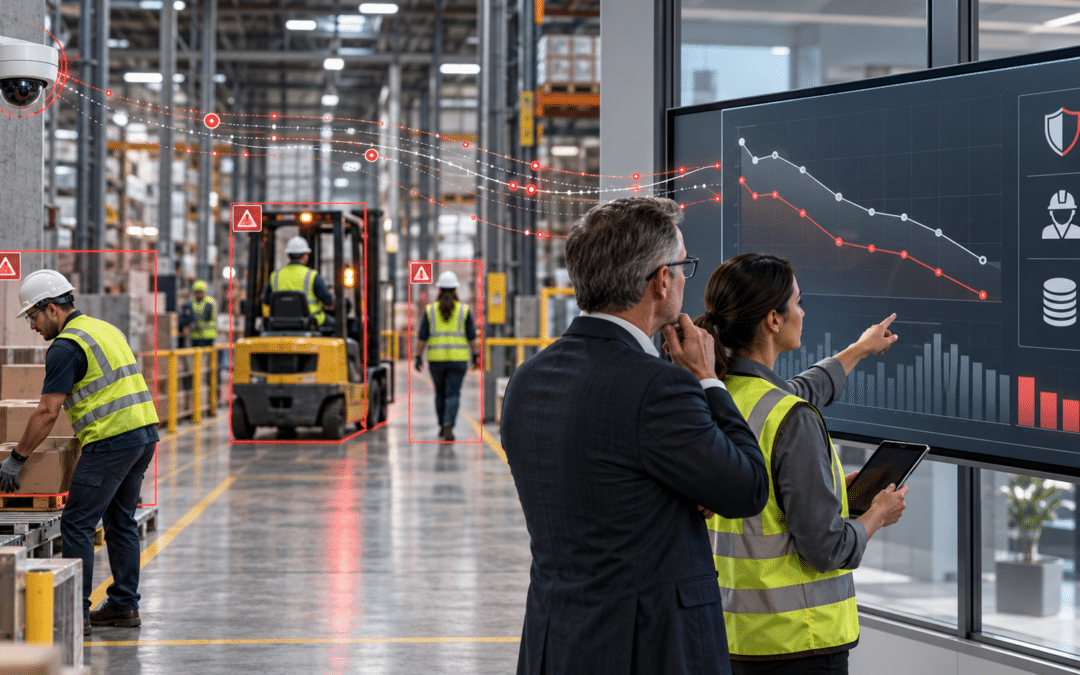
AI can connect safety and finance. Partners in the Tompkins Ventures network use AI camera technology to find and fix floor-level safety issues. The same platforms tie improved safety to claims and workers’ comp premiums. That gives safety leaders numbers finance already trusts.
Because environmental, health and safety (EHS) teams are justifiably proud of a 35% reduction in injury rates. But showing a 74% reduction in workers’ comp claims and a 20% to 30% cut in total cost of risk will wake up the finance team. For years, our partners’ platforms have delivered those and similar numbers in wholesale and warehousing, construction, manufacturing, restaurants, food processing and retail – almost everywhere people work.
Why Safety ROI Is So Hard to Prove
Safety ROI measures what a safety program returns against what it costs. The return comes from fewer injuries, fewer claims and lower workers’ compensation costs. The cost covers people, training, equipment and technology.
Some costs never appear on an invoice. Downtime, overtime to cover absent workers and turnover after an injury all cut into margin. The Occupational Safety and Health Administration’s (OSHA) Safety Pays tool helps companies estimate these indirect costs.
Safety and finance also count the same events in different terms. EHS teams track hazards, near misses, corrective actions and work-related injuries and illnesses. Finance tracks what those workplace injuries cost – claims and insurance premiums, the core of total cost of risk.
So when a CFO asks which safety investments reduced cost, the answer is often an educated guess. Workplace accidents may fall in the same year workers’ compensation premiums decline. But without a link between specific fixes and specific claims, nobody can prove one caused the other.
As time goes by, that lack of correlation could put safety programs on the chopping block. That will cost the company money, time and, potentially, lives.
Old Safety and Insurance Models Move Too Slowly
Many safety programs still depend on human observation. A supervisor walks the floor, a consultant audits a site or a safety manager reviews incident reports. Each method catches real problems. But safety leaders cannot be everywhere, and observation covers only the moments someone is watching.
A thorough review also takes time. Assessing an entire enterprise could take six months. By the time safety specialists collect data, analyze it, make changes and see fewer claims, conditions on the floor may have changed.
Workers’ compensation pricing adds another wrinkle. Premiums depend on the experience modification rate. That rate looks back several years, and insurance companies base premiums on past claims. That means this year’s safety improvements may not reduce premiums until a few years down the road.
Broad policies that cover all claims, no matter how severe, add additional costs. Safety managers may have reduced the risks behind those claims, but they often have no clear way to prove that to insurance companies.
So companies might be paying for coverage they do not need. And safety teams fix problems, while finance waits years to learn whether the interventions paid off. That assumes finance waits that long before cutting funding for “unproven” safety programs.
What Better Safety ROI Requires
Proving safety ROI means tying current data to cost. AI platforms from Tompkins Ventures partners analyze footage from cameras and flag problematic behavior as it happens.
The AI watches for unsafe contact between workers and equipment. It spots patterns such as heavy lifting, awkward postures and repetitive tasks that can cause fatigue and injure workers. It then ranks the alerts by severity. Each alert goes to both safety leads and risk managers, so serious hazards move to the top of the list.
The platforms also automate OSHA and safety checks and help standardize safe processes across job sites. Reporting gets simpler, and audits are easier to prepare for.
Then the platforms turn what they find into data finance can use:
- AI analyzes workers’ compensation claims to forecast the frequency and severity of future injuries.
- Reports match completed fixes against later claim trends. Leaders can see which interventions reduced risk most.
- Companies with several sites get one consistent view. Leaders can compare safety performance by location and hold every site to the same standard.
These platforms also track how quickly the claims team first contacts an injured employee and how soon that employee returns to work. Both measures affect how long a claim stays open and how much it costs. Alerts on delays in care let teams step in before costs build.
Finance measures the result through total cost of risk. That figure combines insurance premiums, the losses a company pays itself and the cost of administering claims. Risk and finance teams can compare insurance structures side by side. Within 24 hours, they can see the premium trade-offs and the effect on total cost of risk.
Better forecasts help companies that self-insure part of their risk. They can decide how much of each loss to pay themselves before coverage applies. And they can avoid holding more cash in reserve than needed.
Translating Safer Workplaces Into Lower Insurance Costs
The platforms send reports that summarize alerts, actions and overall risk level directly to leadership. The reports connect safety performance to claims costs and to the premium the company pays at renewal.
No one has to log into a dashboard. Executives can see the company’s safety record and what it costs.
That record matters when the workers’ compensation policy comes up for renewal. The company can document fewer hazards and work-related injuries or illnesses. Over time, that record can lower premiums, and the savings go straight to the bottom line.
One delivery company that reduced its injury rate by 23% expected to save $300,000 on its next workers’ compensation policy.
In another case, a midsize structural steel contractor tested a Tompkins Ventures partner’s platform at four high-risk sites. In the first 90 days, the tool flagged more than 200 violations involving protective equipment and fall protection.
The platform also reviewed the contractor’s open claims and flagged five likely to exceed $500,000 each. Early intervention on those claims reduced payouts by $1.2 million. The contractor projected a 33% reduction in total cost of risk within 12 months.
Returns also show up on the floor, because workers notice a culture that takes their safety seriously. When leaders act on what the data shows, that culture grows.
Turn Safety Into a Case Finance Accepts
Tompkins Ventures connects companies with partners that pair workers’ compensation coverage with AI-powered prevention. Companies have reported reductions of 20% to 30% in total cost of risk.
Those results build the business case for safety programs and show finance their true value. Talk with Tompkins Ventures, and the next budget review can start with the numbers instead of the question.
Related Reading
- Safe Workplaces Rarely Make Headlines
- Can an App Save Lives? AI Industrial Safety Goes Mobile
- Artificial Intelligence Insights Transform Worker Safety

Tompkins Ventures matches your enterprise’s challenges with our network of 1000s of Commercial Partners, Capital Partners and Consulting Partners. Our toolbox is unlimited, as every Tompkins Ventures Partner has decades of experience helping companies address the five major factors for business success: Leadership, Capital, Technology, Supply Chain/Facilities and Procurement. In today’s business environment of continual disruption, even the best companies do not do everything great. Your core competency is your business. Our core competency is selecting the right Partner(s) to work with your executive teams to make good companies great. Business strategy and supply chain expert Dr. James A. Tompkins founded Tompkins Ventures in 2020. Our network is based in the U.S. but operates on all continents except Antarctica.