
With One Debate Settled, Let’s Examine Microshifting
Every company is still fighting the same fight over remote work. Office or home. Five days a week or three, mandate or perk.
That fight is already over.
Six years after the pandemic struck, fair-minded observers agree that remote and hybrid work arrangements can preserve or increase productivity. And the number of hours Americans work from home has barely budged in more than three years, according to the Survey of Working Arrangements and Attitudes.
More flexible work arrangements are a permanent part of the landscape, CEO wishes be … danged.
So if location never mattered as much as we thought, why does the clock still control your day?
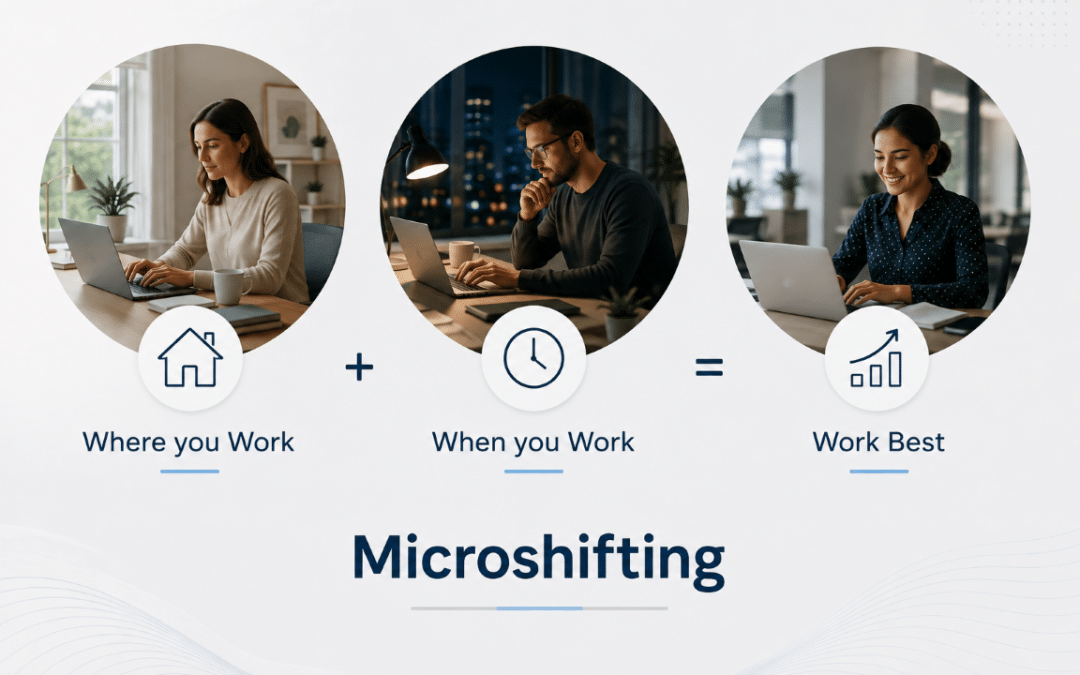
Enter microshifting. Microshifters build their schedule around when they’re most productive, not a strict 9-to-5 work schedule. They carve their day into chunks instead of working straight through.
True, assembly line workers, emergency room personnel and others cannot set their schedule. But in areas where microshifting is possible, many say the technique increases their productivity.
Remote Work Enters the Microshifting Era
John Connolly used to log six hours in front of a screen, then run on fumes for the last two and a half. He was doing remote work the old way, same eight-hour block, just moved from an office to a laptop.
Now, the financial adviser told The Wall Street Journal, he works before his toddler wakes and then breaks for breakfast with his family. Then he puts in about four hours, breaks again for lunch, then returns around 4 p.m. and works until dinner. Some nights he logs back on after his son is in bed.
That is microshifting. Building blocks of focused work around when a person actually produces their best output. In between, they take real breaks.
That’s a far cry from copying your old office hour schedule by sitting in front of your laptop for eight or nine hours straight, with maybe 15 minutes for lunch.
Mark Pacitti told the newspaper that he built his research firm around that idea from day one.
“We focus on output and deliverables,” he said, not hours logged.
His team at Woozle Research works in whatever stretches of time produce their sharpest thinking, and Pacitti works the same way himself.
For insightful leaders, results replaced time as the metric.
Microshifting Demands Discipline, Not Just Freedom
Microshifting sounds like freedom. Done wrong, it becomes something closer to a life sentence.
Cali Williams Yost’s firm helps companies design flexible work policies. She told The Wall Street Journal that without clear boundaries, employees can lose track of when the workday actually ends. Remote workers drift into round-the-clock availability.
They’re checking email at 9 p.m. because nothing marked the line between on and off. That’s the exact opposite of work-life balance, and a fast way to tank employee engagement.
And a team of people all doing their own thing, without company-wide clarity, adds up to a workday with no edges at all.
Workers who do microshifting well must consider it more than a vibe. They must intentionally design their work, whether they’re fully remote or operating under one of many hybrid work models.
Take Whitney Munro, who runs a boutique consulting firm from home managing five full-time employees and a bench of freelancers. She names her three biggest priorities before 10 a.m., then blocks her calendar and ignores email until that block ends.
Then she walks her dogs. She returns to work in the afternoon, breaks for lunch and a load of laundry, then puts in a final stretch before dinner.
When Munro is fried, she doesn’t push through. She pushes the task to tomorrow morning instead.
Nobody assigned her that schedule. She built it, then held herself to it.
Measure Problems Solved, Not Hours Spent
Hybrid workplaces or remote work do not solve the real problem. Neither does sitting at an office desk 40 to 50 hours a week.
The real challenge is solving your clients’ problems.
I run more than 50 business calls a week. Most people on the other end are in a home office, not a corner office downtown.
That means the old way of measuring work no longer applies.
Take a typical supply chain advisory project. Teams used to fly to a client’s site for the first week, then stay there for most of an eight-week engagement. After that, every question about the floor meant another trip back to examine it in person.
Now, one person on-site records video with a phone. The rest of the team studies the footage from wherever they’re working, day or night. When a question comes up, like which way a box turns on the conveyor, they can examine the clip instead of booking another flight.
That’s a better result, not just a cheaper one. New team members get up to speed on a few videos and a couple Zoom calls instead of a week of shadowing on-site. And it cuts what companies would otherwise spend on office space, not just travel, both items that go straight to the bottom line.
I don’t care how many days per week someone works from a coffee shop, home or company desk. I don’t care whether they set up fully remote or operate in a hybrid work model.
I care whether they solve the client’s problem.
That’s the same argument behind microshifting, just scaled up to an entire company. Measure the work. Let the clock take care of itself.
What This Means for Leaders Weighing Hybrid or Remote Work
Stop managing where people sit. Start managing what they finish.
That’s the entire playbook, and it works whether you mandate five days in the office, run a hybrid work policy or go fully remote like Tompkins Ventures. Location was never really the lever. Output was.
Give people the outcome and the deadline. Let them build the schedule around when they do their best work, not the other way around. Set the guardrails Munro and Yost point to: clear priorities, real breaks, some shared hours for collaboration. Then get out of the way.
Your employees might work a few hours, take a walk, then push through another stretch before lunch. After the afternoon session, maybe they shoot hoops at the YMCA before finishing up back at their desk.
As long as they meet their deliverables and solve client problems, it’s all good.
Remote work already settled the where question. Microshifting is settling the when question. The next disruption for your business won’t come from where your competitor’s employees work. It’ll come from how well they measure what those employees actually deliver.
I’m curious how your team is handling this. Reach out and walk me through it.
Related Reading
- Do Amenities Solve Back to the Office Blues?
- Employees Should Choose Their Hybrid Work Schedule
- The Future of Work Is Here — and It’s Not Going Back

Jim Tompkins, Chairman and founder of Tompkins Ventures and Tompkins Solutions, is an international authority on designing and implementing end-to-end supply chains. Over five decades, he has designed countless industrial facilities and supply chain solutions, enhancing the growth of numerous companies. Jim earned his B.S., M.S. and Ph.D. in Industrial Engineering from Purdue University.