
New Realities and Workflows Require New Frameworks
For every organization truly benefiting from Artificial Intelligence today, hundreds more simply talk about it. They host webinars, publish white papers and sprinkle “AI‑powered” across their marketing decks.
Yet they fail to provide their teams with the time, training or guardrails needed to actually use these tools in meaningful ways. This gap – between AI aspiration and AI execution – is widening.
Why? Research from Harvard Business Review and Fortune gives us some clues. Most firms struggle to capture real value from artificial intelligence because people and processes fail. Not the technology. And while two‑thirds of leaders expect employees to learn AI skills, just one‑third said companies provide guidance.
That reveals a deeper problem: the term Artificial Intelligence itself is misleading and increasingly counterproductive.
The word “artificial” carries baggage. It implies something fake or insincere. Artificial plants, flavors and smiles. Even the dictionary reinforces the idea that “artificial” means unnatural.
When leaders introduce “Artificial Intelligence,” many employees subconsciously hear: This is synthetic. This is something replacing what is real. No wonder adoption stalls.
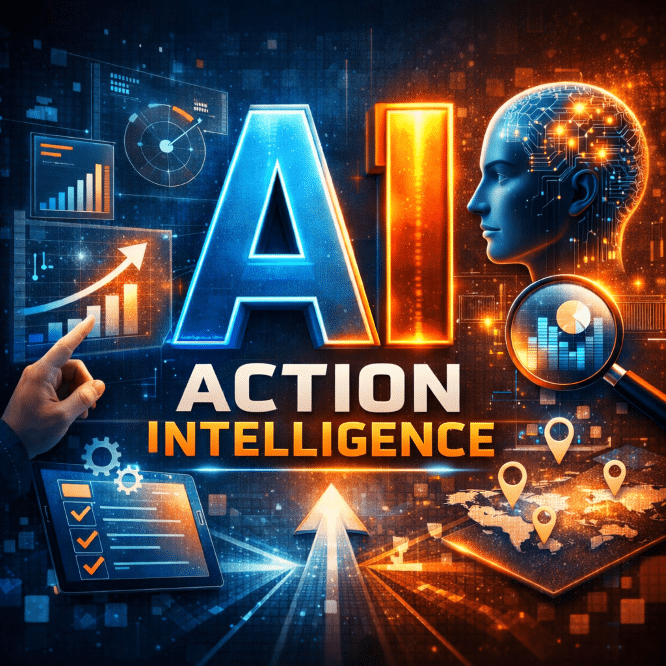
That points to a problem of framing, not necessarily technology. If instead of thinking “unnatural,” what if the workforce understood AI as a catalyst for human action? What if AI stood for Action Intelligence?
The Rise of the Machines Includes People
Action Intelligence reframes AI from something mysterious to something practical and empowering. It doesn’t focus on the “intelligence” of the machine. Instead, it centers on the intelligence of the actions we take because of the machines.
Under this lens, AI accelerates human doing. There is no replacement for human thinking. But action Intelligence can help humans turn data into decisions, insights into initiatives, ideas into execution, complexity into clarity and hesitation into momentum.
This shift matters because organizations don’t succeed by knowing more. They succeed by acting on what they know. They succeed with faster cycle times, higher decision quality and reduced friction – metrics that leaders can measure.
Why Companies Talk About AI but Don’t Benefit
If your company is stuck in the “AI theater” trap, you’re not alone. MIT researchers found that only about 5% of enterprise generative‑AI pilots deliver rapid revenue growth; the rest stall.
Face it: Most everybody is still experimenting. If you need signs of that stall, here are a few:
- Lots of talk, no process change: Executives announce initiatives, yet workflows remain untouched.
- Tiny pilots that never scale: Just look at the 95% failure rate noted above. Without training, experimentation or examples of best practices, AI becomes a buzzword.
- One or two whiz kids: Early adopters experiment on their own, but others avoid it. Without strategy or training, most employees hesitate. Leaders expect instant productivity while underestimating the learning curve.
Action Intelligence solves these problems by shifting the focus from adopting technology to building capability. It asks: What actions do we want to take more effectively, and how can these new technologies help us take them?
AI vs. Generative vs. Agentic
By the time you read this, perhaps we’ll have another type of AI. But for now, here are working definitions for traditional artificial intelligence, generative AI and agentic AI. All use some form of natural language processing (NLP).
Traditional AI, often called machine learning, enables computers to learn from examples and make predictions or classifications. Machine learning models with access to large amounts of labeled data excel at tasks such as detecting fraud or recommending products.
Generative AI took the world by storm in November 2022 with the release of ChatGPT 3.5. These large language models (LLMs) can create new text, images and code based on patterns in training data. They can respond to plain‑language prompts.
Generative models can draft documents, summarize information and translate complex language into plain terms. However, they frequently hallucinate, inventing things that aren’t there.
So they require fastidious fact‑checking.
Agentic AI executes multistep tasks autonomously to achieve a goal. It can plan, decide and act across different tools with minimal human intervention. Agentic AI proactively manages workflows, orchestrates resources and learns through reinforcement to adapt to changing conditions. Whereas generative AI creates content, agentic AI performs complex chains of actions.
Importantly, AI capabilities are designed to augment, not replace, human judgement.
Action Intelligence as a Leadership Framework
When leaders adopt Action Intelligence, they change their focus. They no longer ask, “How do we implement AI?” Instead, they ask, “How do we empower people to act smarter, faster and with more confidence?”
This reframing leads to four practical leadership commitments:
1. Make AI a skill, not a slogan: Treat AI literacy like digital literacy or financial literacy. That means systematic training and learning structures.
2. Build time for experimentation: Redesign workflows to include the appropriate AI tools. Give your teams time to practice, test and refine. Action Intelligence grows through repetition, not mandates.
3. Provide clear use cases: Show employees examples of where AI has helped write better proposals, analyze data faster, improve customer communication, generate ideas, reduce administrative load – you get the picture.
4. Measure actions, not hype: Measure higher quality outputs. Examples include increased optionality and the faster cycle times and better decisions mentioned above.
The real key is requiring humans to show they are actually performing tasks that add value. Action Intelligence thrives when people understand why it matters to their daily work.
Action Intelligence, the Human Advantage – and ’57 Chevys
The irony is that the more powerful these technologies become, the more valuable human judgment becomes. Action Intelligence frees people from low‑value tasks so they can focus on creativity, relationships, strategy and problem‑solving.
Artificial Intelligence, generative AI and agentic AI handle the heavy lifting. Humans interpret, question and apply results. People have the domain expertise and empathy.
Humans also have something machines never can replicate. We have the tacit knowledge that comes from interacting with people in the real world.
But combined, humans and AI can create momentum. Such a partnership requires leaders to invest in AI, people and the way they work together.
In the end, people and machines will work together. Kind of like race car drivers and their automobiles. And if you’ve ever heard a car enthusiast wax nostalgic about their ’57 Chevy, you know such a partnership is deeply human.
A New Language for a New Era
Language shapes behavior. The term “Artificial Intelligence” has served its purpose, but it now limits imagination and fuels resistance. Action Intelligence offers a better framing for the next decade of work.
It signals that AI is not something to fear or worship. The various AIs are tools humans use to take smarter actions, develop deeper capabilities and complete specific tasks. Consider AIs as force multipliers for organizations willing to invest in education, time and guidelines.
So get your mind off shiny tools and mystifying algorithms. Build Action Intelligence into the fabric of how your company’s workflows operate.
If you stop talking and start building, you can do more than generate content. Your teams can turn possibility into progress.
Related Reading
- Leveraging AI in Higher Education
- 7 Ways AI and Generative AI Benefits E2E Supply Chains
- The AI Industrial Revolution: Embrace Progress, Learn from History

Jim Tompkins, Chairman and founder of Tompkins Ventures and Tompkins Solutions, is an international authority on designing and implementing end-to-end supply chains. Over five decades, he has designed countless industrial facilities and supply chain solutions, enhancing the growth of numerous companies. Jim earned his B.S., M.S. and Ph.D. in Industrial Engineering from Purdue University.